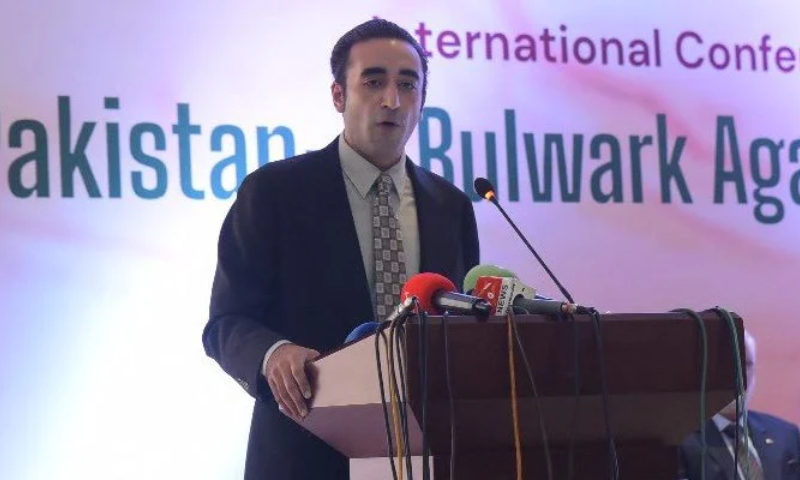
Islamabad, July 2, 2025: Pakistan Peoples Party (PPP) Chairman Bilawal Bhutto-Zardari has extended an offer to India for a “historic and phenomenal partnership” to jointly combat terrorism, urging New Delhi to shift away from confrontation and embrace dialogue for peace in South Asia.
Speaking at a seminar titled “Pakistan: A Bulwark Against Terrorism” in Islamabad, Bilawal called on India to abandon zero-sum approaches and work collaboratively with Pakistan to counter extremism. “We are not rivals in this fight; we are neighbors with a shared duty to protect over a billion lives,” he said.
He urged Indian leadership to adopt a more conciliatory tone and pursue lasting peace, particularly through dialogue on the longstanding Kashmir dispute. “All it requires is for India’s leadership to step down from the high horse that is galloping its republic toward the abyss. Sit with us. Talk to us. Let us resolve Kashmir in line with the aspirations of its people,” Bilawal stated.
Referring to India’s recent suspension of participation in the Indus Waters Treaty (IWT) — a key water-sharing agreement signed in 1960 — Bilawal criticized what he termed the “weaponisation of water.”
“Let us end this dangerous trend and build a peace as mighty and enduring as the Himalayas,” he said. “Let us return to our shared legacy rooted not in hatred, but in the ancient soil of the Indus Valley Civilization.”
His remarks come amid heightened tensions between the two nuclear-armed nations, following India’s allegations of Pakistani involvement in the killing of 26 civilians in Indian Illegally Occupied Jammu and Kashmir (IIOJK) earlier this year. Islamabad has strongly denied the charges. The incident marked one of the worst flare-ups in recent years before a ceasefire agreement helped ease hostilities.
Pakistan also welcomed a recent ruling by the Permanent Court of Arbitration, which reaffirmed that India could not unilaterally suspend the Indus Waters Treaty — a move that had drawn strong criticism from Islamabad.
Highlighting Pakistan’s extensive experience in counterterrorism, Bilawal invited the international community to engage with Pakistan’s institutions. “Come train with us. Learn from our armed forces, our special forces, our police. We have fought — and continue to fight — one of the most prolonged and complex counterterrorism battles in the world,” he said.
He also offered access to Pakistan’s robust counterterrorism data and institutional expertise. “Study our datasets. Walk through a Pakistan rebuilt from the ashes of terror. There are few places with a clearer ‘before and after’ story.”
Concluding his address, Bilawal emphasized reconciliation over rivalry. “Let perception give way to partnership. Extending a hand in peace is not a sign of weakness — it is a mark of wisdom.”