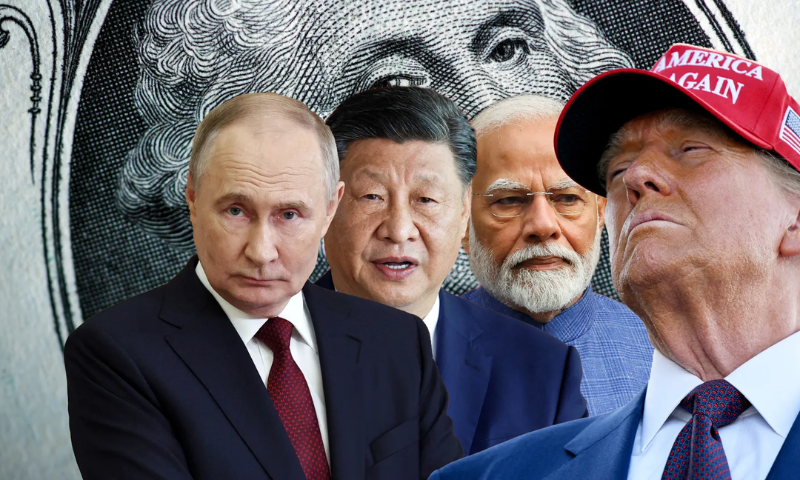
Washington, July 7, 2025: U.S. President Donald Trump on Sunday issued a stark warning to countries aligning themselves with BRICS, threatening to impose an additional 10% tariff on nations whose policies oppose U.S. interests.
“Any country aligning themselves with the Anti-American policies of BRICS will be charged an ADDITIONAL 10% tariff. There will be no exceptions to this policy,” Trump wrote on social media.
The warning follows growing global concern over Washington’s increasingly aggressive trade stance under Trump’s administration. BRICS — an economic bloc originally comprising Brazil, Russia, India, China, and South Africa — has expanded to include Egypt, Ethiopia, Indonesia, Iran, Saudi Arabia, and the UAE, representing over half of the world’s population.
Trump, who has frequently criticized BRICS and its efforts to challenge U.S. economic dominance, particularly through reforms to the IMF and proposals for a non-dollar global currency, now appears poised to escalate tensions further.
The U.S. had set a July 9 deadline for countries to finalize new trade deals. However, tariffs are now expected to take effect on August 1, according to Commerce Secretary Howard Lutnick.
Trump confirmed that he will be sending letters to 10–15 countries this week, outlining their new tariff rates unless agreements are reached. Treasury Secretary Scott Bessent added that his office had received “a flood of new offers and proposals,” suggesting a late surge in negotiation efforts.
“They’re going to be tariffs. The tariffs are going to be tariffs,” Trump said over the weekend when asked about the implementation timeline.
So far, the U.S. has secured full or partial trade agreements with the UK, Vietnam, and China, though key issues remain unresolved:
- UK Deal: U.S. to reduce tariffs on British cars from 27.5% to 10% (up to 100,000 vehicles); aerospace tariffs dropped to zero. In return, Britain will remove tariffs on U.S. ethanol and beef.
- Vietnam Deal: Vietnamese exports to the U.S. will be taxed at 20%, while U.S. goods will enter Vietnam tariff-free. However, third-country goods transshipped through Vietnam into the U.S. will be taxed at 40%.
- China Partial Deal: U.S. tariffs on certain Chinese imports reduced from 145% to 30%; China’s tariffs on American goods cut from 125% to 10%. China also scrapped export bans on critical minerals.
Tensions flared after BRICS finance ministers, following a two-day summit in Rio de Janeiro, issued a statement condemning U.S. tariffs as a “threat to the global economy” and a source of uncertainty in international trade.
This statement reignited fears in Washington about the increasing cohesion and influence of BRICS, particularly as it seeks to reshape global financial structures traditionally dominated by the West.
“Moving away from China in some sectors is far more difficult than it sounds,” said Andrew Wilson, Deputy Secretary General of the International Chamber of Commerce.
“There are no viable global alternatives in many areas where China leads.”
With the August 1 deadline looming, the EU remains in talks with Washington to maintain the provisional 10% tariff on most goods. Negotiations are also ongoing to reduce a 25% duty on EU cars and a 50% tariff on steel and aluminum.
Trump’s latest tariff threats mark a continuation of his hardline trade agenda. In April, he unveiled sweeping new tariffs — some as high as 50% — during what he called “Liberation Day”, though those were temporarily suspended for a 90-day negotiation window ending July 9.
With that deadline now expiring, Washington appears ready to escalate economic pressure on nations it views as strategically aligned against U.S. interests — particularly those leaning toward BRICS-led initiatives.