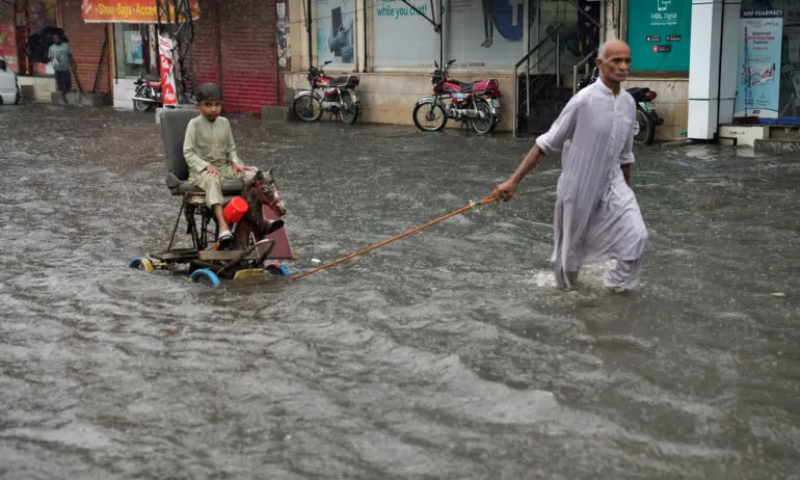
Islamabad, July 14, 2025: At least 111 people, including 53 children, have died across Pakistan due to monsoon-related incidents since the onset of seasonal rains in late June, according to data released by the National Disaster Management Authority (NDMA) on Monday.
The NDMA reported that electrocution remains the leading cause of fatalities, followed by deaths from flash floods. Among the casualties were 13 tourists swept away while sheltering on a raised riverbank during sudden flooding in late June.
The Pakistan Meteorological Department (PMD) has now issued fresh warnings, forecasting heavy to extremely heavy rainfall across multiple regions of the country from July 14 to 17, under the influence of a low-pressure area (LPA) currently located over northwest Madhya Pradesh, India. This system is expected to enter Pakistan in the coming 24 to 72 hours.
“Strong monsoon currents will penetrate central and upper Pakistan from July 15, accompanied by a westerly wave over the upper regions,” said the PMD.
Region-wise forecast:
- Kashmir & Gilgit-Baltistan: Very heavy rainfall, thundershowers, and isolated downpours expected in Neelum Valley, Muzaffarabad, Skardu, Gilgit, and surrounding areas from July 14–17.
- Khyber Pakhtunkhwa: Extremely heavy rains forecast in Dir, Swat, Kohat, Peshawar, and Waziristan from July 14 night to 17.
- Punjab & Islamabad: Scattered heavy to very heavy rain expected in Rawalpindi, Lahore, Faisalabad, Sargodha, Multan, and DG Khan divisions from July 14 evening to 17.
- Balochistan: Showers expected in Quetta, Khuzdar, Zhob, and Lasbella between July 14 and 16.
- Sindh: Moderate rain with occasional heavy falls in Tharparkar, Larkana, Sukkur, and surrounding districts. Light rain is likely in Karachi.
The PMD warned of flash flooding in hill torrents and local nullahs, particularly in DG Khan, Rajanpur, Dir, Swat, Kohistan, and Gilgit-Baltistan. Urban flooding is also likely in low-lying areas of Punjab, KP, and Sindh, while landslides and road closures may occur in mountainous regions.
Authorities have been advised to remain on high alert, activate emergency response plans, and ensure the safety of citizens, especially in vulnerable zones. Travellers and tourists are urged to avoid non-essential movement in affected areas and stay updated on weather developments.
Monsoon rains typically bring 70 to 80 percent of South Asia’s annual precipitation between June and September. While vital for agriculture and water supply, they also pose a risk of flooding, landslides, and infrastructure collapse, particularly in densely populated or poorly constructed areas.
Experts warn that climate change is amplifying the intensity and unpredictability of monsoon patterns. Pakistan, home to over 240 million people, is among the countries most vulnerable to climate impacts.
In 2022, unprecedented floods submerged one-third of the country, killing 1,700 people and displacing millions. Many communities have yet to fully recover from the devastation. In May this year, 32 more lives were lost in extreme weather events, including powerful hailstorms.