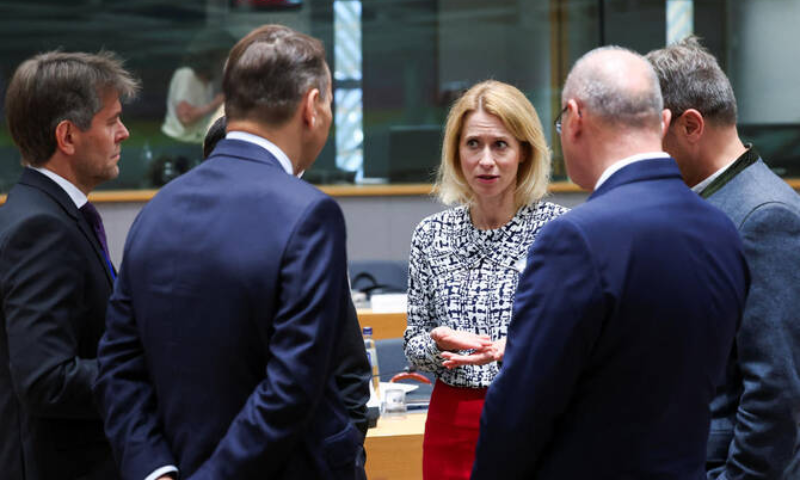
Brussels, July 15, 2025: European Union foreign ministers met in Brussels on Tuesday to consider potential action against Israel over its military offensive in Gaza, but internal divisions continue to stall any meaningful consensus.
The EU’s foreign policy chief, Kaja Kallas, proposed a list of ten measures after concluding that Israel had violated the EU-Israel cooperation agreement, which is tied to human rights commitments. Her recommendations ranged from suspending the bilateral accord, limiting trade ties, and ending visa-free travel, to sanctioning Israeli officials and imposing an arms embargo.
Despite mounting public concern over the humanitarian catastrophe in Gaza, diplomats say EU states remain too sharply divided to move forward. Some member states remain staunch allies of Israel, while others push for greater accountability.
“I can’t predict how the discussion will go,” Kallas admitted before the meeting. She added that discussions would likely focus on using diplomatic leverage to improve the humanitarian situation on the ground, rather than imposing sanctions.
Last week, Kallas announced a tentative agreement with Israeli Foreign Minister Gideon Saar to ease the flow of aid into Gaza, including opening more border crossings and restoring vital services like water and electricity. While welcoming these steps, Kallas described the situation in Gaza as still “catastrophic”, warning that further efforts were essential for real change.
Foreign Minister Saar, meanwhile, dismissed the EU proposals outright. “I’m sure not any of them will be adopted,” he told reporters in Brussels. “There’s no justification whatsoever.”
The EU only agreed to reassess its cooperation agreement with Israel after military operations resumed in Gaza this March following the collapse of a short-lived ceasefire. Until then, deep divisions between pro-Israel and pro-Palestinian member states had blocked any coordinated EU stance.
A clear example of these tensions emerged again Tuesday, as Hungary signaled its continued opposition to further sanctions, including those targeting Israeli settlers in the occupied West Bank. This came despite a renewed push by France’s Jean-Noël Barrot, who urged action in line with international law.
The conflict began on October 7, 2023, when Hamas launched a deadly attack on southern Israel, killing 1,219 people, mostly civilians, and taking 251 hostages. According to Israeli authorities, 49 hostages remain in Gaza, including 27 presumed dead.
Israel’s retaliatory offensive has since devastated Gaza. The Gaza Health Ministry, operated by Hamas, reports that at least 58,386 Palestinians, the majority of them civilians, have been killed. The United Nations regards these figures as credible and has repeatedly called for an end to the hostilities.
While the EU has yet to take concrete action, the mere discussion of sanctions signals a notable shift in tone from Brussels. However, without a unified position, any significant policy move remains unlikely in the immediate future.