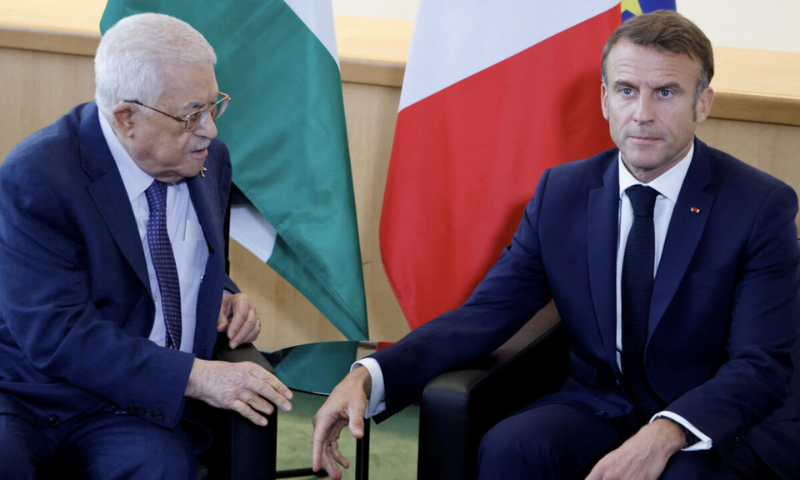
Paris, July 25, 2025: French President Emmanuel Macron announced on Thursday that France will formally recognize the State of Palestine, making it the first G7 nation to do so. The move, Macron said, aligns with France’s “historic commitment to a just and lasting peace in the Middle East.”
The announcement, made via the president’s official account on X.com, follows months of speculation over France’s position on Palestinian statehood. Macron stated that the formal recognition would be announced at the United Nations General Assembly in New York this September.
The announcement sparked swift and sharp condemnation from both the United States and Israel.
U.S. Secretary of State Marco Rubio, posting on X.com, said:
“The United States strongly rejects Emmanuel Macron’s plan to recognize a Palestinian state at the UN General Assembly. This reckless decision only serves Hamas propaganda and sets back peace. It is a slap in the face to the victims of October 7.”
Israeli Prime Minister Benjamin Netanyahu also condemned the move, calling it “a dangerous decision made in the shadow of the October 7 massacre.”
“A Palestinian state next to Tel Aviv would be a launchpad to annihilate Israel,” he said in a strongly worded statement, accusing France of “rewarding Hamas terrorism” and warning of further deterioration in bilateral relations.
Israeli officials have repeatedly warned against any formal recognition of Palestinian statehood, arguing that it legitimizes Hamas and undermines peace efforts. In Israeli political circles, Macron’s move has been labeled as part of a “Crusade against the Jewish state.”
The announcement came on the same day that international media reported the U.S. and Israel had withdrawn from the Gaza ceasefire negotiations in Qatar, citing Hamas’s alleged failure to negotiate in good faith.
Once formalized, France will join a growing list of European nations—including Spain, Ireland, Norway, and Slovenia—that have recognized Palestinian statehood in recent years.
However, France’s recognition carries additional weight: it is the only EU member with a permanent seat on the UN Security Council and is both a nuclear power and home to the largest Jewish and Muslim populations in Western Europe. This unique geopolitical standing has amplified the global significance of Macron’s decision.
Macron’s announcement comes amid growing global concern over the humanitarian crisis in Gaza, where thousands of civilians are reportedly suffering from starvation following months of conflict. The ongoing war erupted after the October 7, 2023, Hamas-led attacks on Israel, which left over 1,200 people dead and triggered a prolonged Israeli military offensive.
Many world leaders, including Colombian President Gustavo Petro, have criticized Israeli Prime Minister Netanyahu’s handling of the war and the lack of a clear post-war governance plan for Gaza, which has been left in ruins.
France has not yet specified which territorial boundaries it will recognize as part of a future Palestinian state. However, Macron emphasized the importance of a ceasefire in Gaza, the release of all hostages, the disarmament of Hamas, and the strengthening of the Palestinian Authority’s role across all Palestinian territories.
Despite the symbolism of France’s decision, it is unlikely to change the legal status of Palestine at the UN, where full membership requires Security Council approval. The United States has repeatedly used its veto power to block such efforts. In 2012, Palestine was granted permanent observer status, a position it still holds today.
More than 140 countries around the world have recognized the State of Palestine since its declaration of independence in 1988. Early recognizers included China, India, Russia, and Malaysia. France now joins this group at a time when calls for a two-state solution are being reignited amid the deepening humanitarian and political crisis in the region.