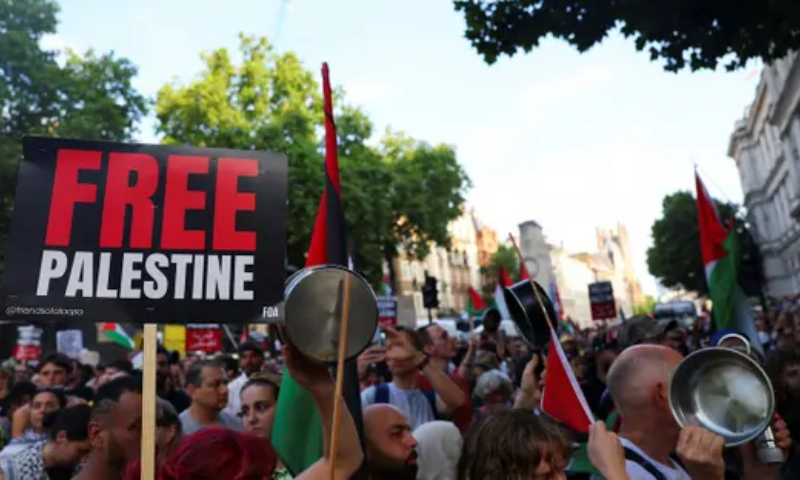
United Nations, July 26, 2025: A long-stalled push for a two-state solution is set to regain momentum next week as UN member states gather in New York for a high-level conference, co-chaired by France and Saudi Arabia, aimed at reviving efforts to resolve the Israeli-Palestinian conflict.
The July 28–30 conference, originally delayed from June, has been reinvigorated by French President Emmanuel Macron’s recent announcement that France will formally recognize the State of Palestine in September. The move is widely seen as a diplomatic game-changer amid escalating tensions and a deepening humanitarian crisis in Gaza.
“Macron’s announcement changes the game. Other participants will be scrambling to decide if they should also declare an intent to recognise Palestine,” said Richard Gowan, analyst at the International Crisis Group.
According to UN data, at least 142 of the 193 member states now recognise the Palestinian state proclaimed in 1988. France’s forthcoming recognition will add to this growing global consensus, even as key Western powers such as Britain and Germany remain hesitant to follow suit in the immediate term.
The United Nations first proposed the partition of Palestine into Jewish and Arab states in 1947, leading to the formation of Israel the following year. While the two-state solution has long been endorsed by a majority of nations, it remains elusive amid persistent violence, Israeli settlement expansion, and more than 21 months of war in Gaza.
The current conflict began after a Hamas-led attack on Israel, prompting a massive Israeli military response that has killed tens of thousands of Palestinians, according to humanitarian agencies.
With Israel and the United States opting not to attend, the New York conference is expected to focus heavily on humanitarian concerns and political recognition efforts. Palestinian Prime Minister Mohammad Mustafa, alongside representatives from over 100 countries, will participate in what some diplomats describe as a “last-ditch effort” to salvage the two-state vision.
Beyond recognition of Palestinian statehood, the conference will aim to reform the Palestinian Authority, disarm and politically exclude Hamas and encourage normalization of ties between Arab states and Israel.
However, officials caution that no announcements on new normalization agreements are expected next week. The UK has reiterated that it will not recognize Palestine unilaterally, insisting instead on a comprehensive regional peace framework.
“The two-state solution is more threatened than ever—but also more necessary than ever,” said a French diplomatic source, citing the absence of viable alternatives.
The absence of Israel and the U.S. from the talks underscores the diplomatic divide. Israel’s ambassador to the UN, Danny Danon, has declined to attend, arguing that any peace process must begin with condemnation of Hamas and the release of all hostages.
Despite this, the humanitarian catastrophe in Gaza is expected to dominate the conference agenda. “Very fierce criticism of Israel” is likely, said Gowan, as pressure mounts on Tel Aviv to end its military campaign.
“This conference offers a unique opportunity to transform international consensus into a tangible peace plan,” said Palestinian UN envoy Riyad Mansour, calling on participants to show “courage” and “demonstrate resolve to end the occupation and conflict once and for all.”
As the UN prepares to host a gathering where hope, criticism, and diplomatic urgency converge, the world watches for signs of meaningful progress—or renewed deadlock—in one of history’s most intractable conflicts.