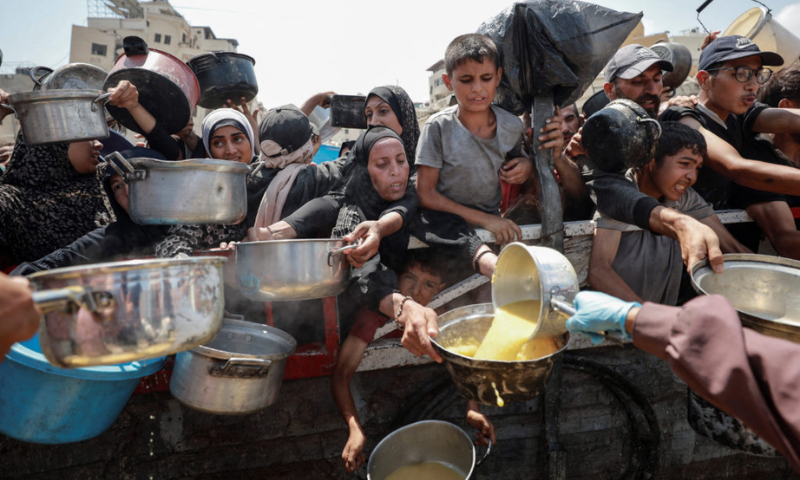
United Nations/Geneva/Cairo, July 29, 2025: Gaza is facing a looming famine and immediate global action is required to prevent mass starvation, the Integrated Food Security Phase Classification (IPC) warned Tuesday, as the Palestinian death toll in the ongoing Israel-Gaza conflict surpassed 60,000.
The grim assessment by the IPC — an international hunger monitoring body — raised the possibility of Gaza being officially declared a famine zone, a designation that could significantly increase international pressure on Israel to allow more humanitarian aid into the besieged territory.
“Mounting evidence shows that widespread starvation, malnutrition, and disease are driving a rise in hunger-related deaths,” the IPC said. It noted that “famine thresholds” for food consumption had already been reached across most of the Gaza Strip and a formal review was underway to determine if the situation meets the criteria for a famine declaration.
For famine to be officially declared, at least 20% of the population must be suffering extreme food shortages, at least 30% of children must be acutely malnourished, and at least two out of every 10,000 people must be dying each day from starvation or related causes.
According to Gaza health officials, at least 147 people, including 88 children, have already died from hunger-related causes — most in recent weeks. Images of severely malnourished Palestinian children have drawn global outrage. U.S. President Donald Trump, a staunch ally of Israel, acknowledged the crisis, stating that “many people are starving” and vowing to establish emergency “food centres” in the region.
Despite growing international criticism, the World Food Programme (WFP) said Tuesday it was still facing restrictions and had not received the necessary permissions to deliver sufficient food aid — even after Israel introduced limited humanitarian pauses on Sunday.
“We’re only getting about 50% of what we’re requesting into Gaza,” said Ross Smith, senior regional programme adviser for WFP, speaking from Geneva. “We cannot meet the population’s needs without significantly scaling up aid volumes.”
Israel has denied allegations of deliberately using starvation as a war tactic. Foreign Minister Gideon Saar acknowledged the humanitarian challenges but dismissed reports of a famine as “lies.”
The humanitarian alarm comes amid the highest recorded death toll in the history of the Israeli-Palestinian conflict. Gaza’s Health Ministry — whose figures are cited by the United Nations and deemed reliable by the World Health Organization — said the toll had now reached 60,000. This surpasses the previous deadliest escalation in 2014, when 2,100 Palestinians and 73 Israelis were killed.
The ongoing conflict was triggered on October 7, 2023, when Hamas militants launched an unprecedented attack on Israel, killing 1,200 people and abducting 251 — the deadliest day in Israel’s history. Israel’s subsequent military campaign has devastated much of the Gaza Strip, displacing millions and triggering widespread destruction.
The new death toll figure does not distinguish between civilians and combatants. Thousands more are believed to be buried under rubble, Palestinian officials and rescue workers said.
Overnight Israeli airstrikes on the Nuseirat refugee camp in central Gaza killed at least 30 people, including 14 women and 12 children, according to doctors at Al-Awda Hospital. Another 13 people were reportedly killed by Israeli fire while waiting for aid along Salahudeen Road. The Israeli military did not immediately comment on the reports.
Meanwhile, diplomatic efforts to secure a ceasefire and release the remaining 50 hostages still held in Gaza — of whom only 20 are believed to be alive — collapsed last week. Prime Minister Benjamin Netanyahu reiterated on Sunday that Israel would continue its military campaign until all hostages are freed and Hamas’ capabilities are dismantled.
In a separate development, the U.S.-backed Gaza Humanitarian Foundation (GHF), established to distribute aid with Israeli cooperation, has come under sharp criticism. The IPC said 88% of Gaza is now under evacuation orders or militarized zones and that most of GHF’s food packages were ineffective due to the lack of water and fuel needed for cooking.
“Their distribution plan would lead to mass starvation,” the IPC’s Famine Review Committee warned, citing a technical analysis of GHF’s rations. GHF defended its operations, stating that its food boxes meet international nutrition standards and are based on ingredient lists used by other aid organizations.
As competing narratives escalate, the humanitarian toll continues to rise. The UN and aid agencies urge immediate, unrestricted access to Gaza, warning that without drastic intervention, the enclave may soon face an officially declared famine — a first in the region’s modern history.