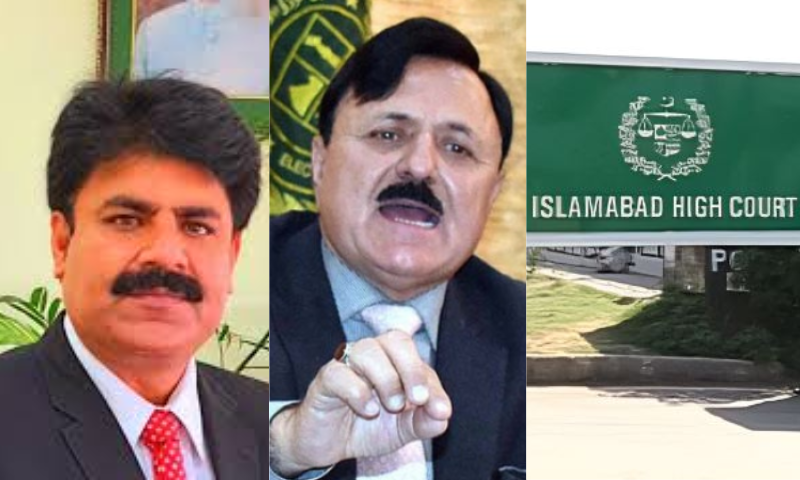
Islamabad, July 30, 2025: In a significant judgment reinforcing constitutional limits and the principle of judicial federalism, the Islamabad High Court (IHC) on Wednesday dismissed a constitutional petition challenging the reappointment of Raja Shahbaz Ahmad as Chief Election Commissioner (CEC) of Gilgit-Baltistan (GB), ruling that it lacked both territorial and subject-matter jurisdiction to hear the case.
The petition, filed under Article 199 of the Constitution, sought to declare the reappointment of the CEC unlawful and requested initiation of a fresh selection process. The Federation of Pakistan, the Government of Gilgit-Baltistan, and the CEC of GB were named as respondents.
According to the petitioner, the statutory tenure of the CEC had expired on July 30, 2022, but he continued in office until July 30, 2024, and was subsequently reappointed via a new oath on July 31, 2024. The petitioner alleged that the reappointment violated mandatory consultative requirements under the Gilgit-Baltistan Order, 2018, as it was carried out without input from the Chief Minister and the Leader of the Opposition in the GB Assembly.
Advocate Supreme Court Hafiz Ehsaan Ahmad Khokhar, representing the CEC, raised a preliminary legal objection, arguing that the Islamabad High Court had no jurisdiction over matters arising exclusively within Gilgit-Baltistan. He maintained that the appointment was made in accordance with Article 97 of the Gilgit-Baltistan Order, 2018, and Section 3 of the Gilgit-Baltistan Chief Election Commissioner (Terms and Conditions) Order, 2014—both being special laws applicable solely to the GB region.
He informed the court that the reappointment was duly notified on February 21, 2024, by the Chairman of the Gilgit-Baltistan Council on the advice of its Vice Chairman, the Governor of GB, and that the appointee had taken oath before the Chief Judge of the Supreme Appellate Court of GB in full compliance with legal formalities.
Citing PLD 2019 SC 357, Mr. Khokhar argued that the Supreme Court of Pakistan had previously held that judicial matters under the GB Order fall within the exclusive jurisdiction of GB’s superior judiciary. He further relied on PLD 2025 Lahore 200, in which the Lahore High Court ruled that a writ of quo warranto must be filed in the court with territorial jurisdiction over the office in question.
Addressing the legality of the reappointment, Mr. Khokhar contended that the GB legal framework imposes no bar on the reappointment of a CEC. He invoked the legal maxim expressio unius est exclusio alterius—what is not expressly prohibited is permitted—and cited 2017 PLC (C.S.) 645, where a court upheld the reappointment of a public official in the absence of an explicit restriction.
He also rejected the petitioner’s reliance on the precedent set in Khawaja Muhammad Asif v. Federation of Pakistan, clarifying that the case pertained to appointments during caretaker governments, whereas the reappointment in question was made by a duly elected government. He emphasized that the Prime Minister acted not as the head of the federal executive but in his distinct capacity as Chairman of the Gilgit-Baltistan Council.
The Federation of Pakistan also supported the reappointment and echoed the stance that the IHC lacked jurisdiction.
In its written judgment, the IHC held that the petition concerned an executive appointment made entirely under the constitutional framework of Gilgit-Baltistan, and that no part of the cause of action arose within Islamabad’s territorial limits.
“Accordingly, this Court is divested of jurisdiction to entertain the instant writ petition either on territorial or subject-matter grounds,” the judgment stated.
The petition was dismissed for want of jurisdiction.