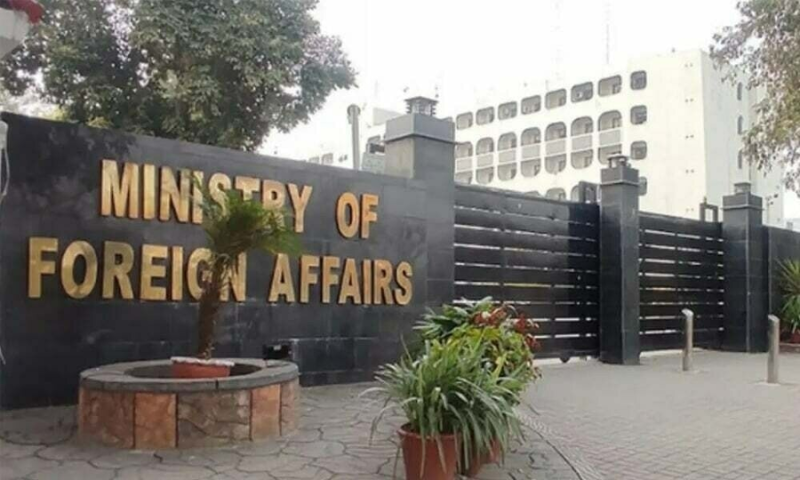
Islamabad, July 30, 2025: Pakistan on Wednesday strongly rebutted Indian allegations linking it to the recent Pahalgam attack, condemning what it called “fabrications” and “provocative claims” made by Indian leaders during a fiery debate in the Lok Sabha on Operation Sindoor.
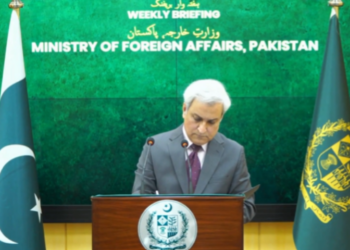
In a strongly worded statement, Foreign Office (FO) spokesperson Shafqat Ali Khan said,
“Pakistan categorically rejects the baseless assertions and provocative claims made by the Indian leadership during the Lok Sabha debate. India should stop acting as judge, jury, and executioner.”
The comments came a day after Indian Home Minister Amit Shah claimed in Parliament that Indian security forces recovered Pakistani voter ID cards and locally produced chocolates from three individuals killed in a gun battle in Indian Illegally Occupied Jammu and Kashmir (IIOJK). Shah alleged that the men were behind the Pahalgam attack.
Prime Minister Narendra Modi, addressing the same session, denied reports that US President Donald Trump or any other world leader had influenced India’s decision to halt hostilities with Pakistan. This came after Trump claimed credit for brokering a ceasefire following a four-day conflict in May that claimed over 70 lives on both sides.
Pakistan termed the Indian narrative as “dangerously distorted,” accusing New Delhi of glorifying conflict for domestic political gains.
“The world knows that India attacked Pakistan without any credible evidence or investigation into the Pahalgam attack,” said Shafqat. “During the night of May 6 and 7, Indian strikes on alleged terrorist infrastructure actually killed innocent men, women, and children.”
He added that India failed to achieve its strategic objectives, while Pakistan successfully neutralized Indian fighter jets and military targets, calling it an “indisputable fact.”
Shafqat criticized India for rejecting Pakistan’s offer of an independent and transparent investigation into the attack and instead choosing the path of “belligerence and unilateral aggression.”
“Against this backdrop, any claims regarding the so-called ‘Operation Mahadev’ hold no significance for Pakistan,” he said, questioning the credibility of the Indian Home Minister’s account.
“Is it just a coincidence that the alleged attackers were killed right at the start of the Lok Sabha debate?”
He also dismissed Indian statements about establishing a ‘new normal’ in bilateral relations.
“As we have already shown through our resolute response in May 2025, Pakistan will forcefully counter any future aggression,” he warned. “For us, the only acceptable ‘normal’ is mutual respect for sovereignty and adherence to the UN Charter.”
Responding to Indian accusations of “nuclear blackmail”, the FO spokesperson called the narrative “misleading and self-serving,” aimed at diverting attention from India’s own escalation tendencies.
“Pakistan deterred India through conventional capabilities. Our guiding principles remain discipline and restraint,” he asserted.
On the Indus Waters Treaty, Shafqat expressed serious concern over India’s move to hold the agreement in abeyance, calling it a “blatant violation of international obligations.”
“India’s unilateral suspension of the treaty strikes at the heart of regional cooperation,” he said, urging New Delhi to immediately fulfill its treaty commitments.
Concluding his statement, Shafqat emphasized Pakistan’s commitment to peace, stability, and meaningful dialogue, particularly regarding the core dispute of Jammu and Kashmir.
“Pakistan, as a responsible state, remains committed to regional stability and peaceful resolution of all outstanding issues through diplomacy and dialogue,” he said.
The remarks mark a sharp escalation in rhetoric as tensions between the South Asian neighbours continue to simmer in the aftermath of May’s conflict and the Pahalgam incident.