Islamabad/New Delhi, August 2, 2025: In the early hours of May 7, 2025, one of the largest air battles in recent decades erupted between Pakistan and India, marking a dramatic escalation in tensions between the two nuclear-armed neighbors. At the center of the clash was the downing of an Indian Rafale fighter jet—India’s prized French-made aircraft—by a Chinese-made J-10C of the Pakistan Air Force (PAF), triggering global attention and raising questions about the future of air combat.
The incident unfolded after midnight when the operations room of the Pakistan Air Force (PAF) lit up with alerts indicating a large formation of Indian aircraft crossing into striking range. Air Chief Marshal Zaheer Ahmed Baber Sidhu, who had been sleeping on a mattress near the operations center in anticipation of Indian aggression, immediately ordered the launch of J-10C fighter jets. The move came in response to Indian airstrikes on targets in Pakistan, carried out in retaliation for an attack in Indian-Illegally Occupied Jammu and Kashmir (IIOJK) that killed 26 civilians—a strike India blamed on Pakistan-backed militants, an allegation denied by Islamabad.
According to a senior PAF official, Sidhu specifically instructed his team to target India’s Rafales.
“He wanted Rafales,” the official told Reuters.
The resulting hour-long nocturnal dogfight reportedly involved over 110 aircraft—a scale unseen in decades—making it one of the most extensive air-to-air engagements in the post-Cold War era.
PAF’s J-10Cs, equipped with long-range PL-15 missiles, managed to shoot down at least one Rafale, according to U.S. officials cited in a Reuters investigation published earlier. The missile was reportedly launched from a range of approximately 200 kilometers (124 miles)—well beyond the Rafale pilots’ perceived threat envelope.
The success of the strike came down to a critical Indian intelligence oversight: an underestimation of the PL-15’s range. Indian pilots operated under the belief that the missiles could not reach them beyond 150 km—based on export variant assessments—leaving them vulnerable.
“We ambushed them,” the Pakistani official said, adding that the PAF also launched an electronic warfare assault aimed at confusing Indian sensors.
Military experts confirmed that situational awareness and real-time coordination played a pivotal role.
“The PL-15 is clearly very capable at long range,” said Justin Bronk, an air warfare analyst at the Royal United Services Institute (RUSI).
“The winner in this was the side that had the best situational awareness,” added retired UK Air Marshal Greg Bagwell.
The Pakistani military reportedly integrated air, land, and space-based assets to form a sophisticated multi-domain “kill chain” using a locally developed system known as Data Link 17. This network linked Chinese and Western hardware—allowing radar feeds from a Swedish surveillance aircraft to be shared with J-10Cs, enabling them to operate with radars off and remain undetected.
Indian officials acknowledged that Pakistan appeared to have better sensor integration during the clash, while India continues working on its own network—complicated by its diverse procurement sources.
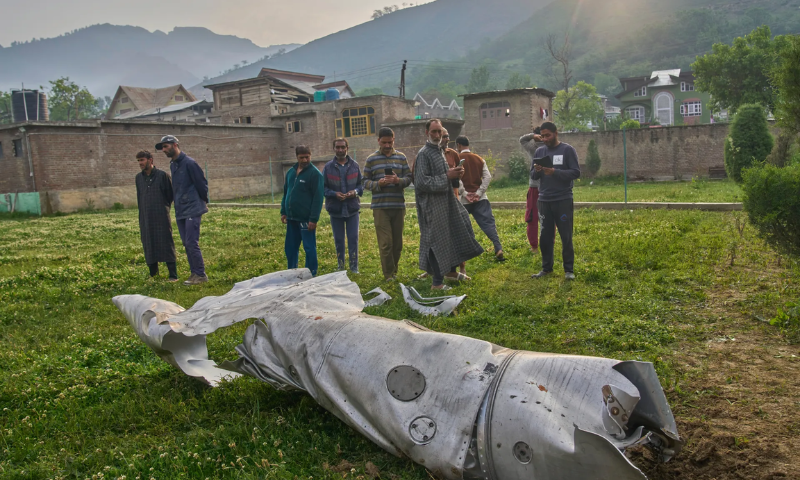
Following the loss of aircraft, including one Rafale and a Russian-made Sukhoi, India altered its approach. It deployed around 70 aircraft during the May 7 strikes, according to Pakistani officials, creating a “target-rich environment” for PL-15 missiles.
On May 10, Indian forces reportedly launched counter-strikes on nine Pakistani air bases and radar installations. One Pakistani surveillance plane, parked in a hangar in the country’s south, was also targeted. Indian BrahMos missiles were used in the retaliatory strikes, with both sides reportedly remaining within their airspace during the engagements.
A ceasefire was eventually brokered later that day through urgent diplomatic intervention by the United States.
India has yet to publicly acknowledge the downing of a Rafale. However, in June, the French Air Force Chief stated he had seen evidence confirming the loss of a Rafale and two other Indian jets. Dassault, the Rafale’s manufacturer, also confirmed the loss of one aircraft in India, though without specific details.
India’s Deputy Army Chief, Lt. Gen. Rahul Singh, later accused Pakistan of receiving “live inputs” from China, including real-time radar and satellite feeds. While Islamabad denies these claims, two PAF officials confirmed that China’s air chief, Lt. Gen. Wang Gang, visited Pakistan in July to study its use of Chinese platforms in multi-domain operations. China has described its military cooperation with Pakistan as “normal” and not directed at any third party.
Meanwhile, Dassault Aviation and Russia’s United Aircraft Corporation (UAC), the maker of the Sukhoi, have declined to comment on the incident.