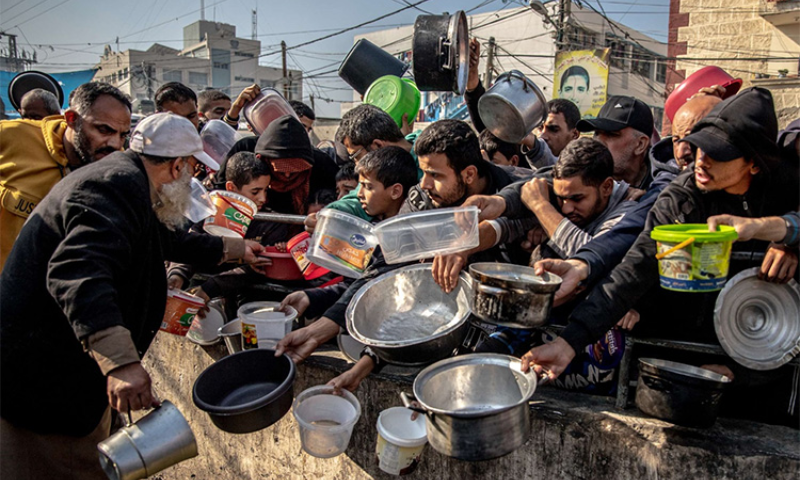
Gaza, August 2, 2025: The United Nations Children’s Fund (UNICEF) has issued a dire warning that Gaza is teetering on the brink of famine, with one in every three residents going days without food amid Israel’s ongoing military campaign.
In a statement released Friday, UNICEF’s Deputy Executive Director for Humanitarian Action and Supply Operations, Ted Chaiban, called on the international community to act urgently to prevent a full-scale humanitarian catastrophe.
“Today, more than 320,000 young children are at risk of acute malnutrition,” Chaiban said, following his recent visit to Israel, Gaza, and the occupied West Bank.
“The malnutrition indicator in Gaza has exceeded the famine threshold… We are at a crossroads, and the choices made now will determine whether tens of thousands of children live or die.”
Chaiban underscored that Gaza is where “suffering is most acute” and that children are dying at “an unprecedented rate.”
The humanitarian toll was underlined on Saturday when 17-year-old Atef Abu Khater reportedly died of malnutrition at al-Shifa Hospital. Once in good health, the teenager was admitted to intensive care earlier this week but did not respond to treatment, local media reported.
According to Gaza’s Ministry of Health, at least 162 people have died from starvation since October 2023, including 92 children. These figures come amid a broader death toll of over 60,000 Palestinians—more than 18,000 of them children—since Israel launched its military offensive in Gaza following the October 7 Hamas-led attacks.
Palestinians in Gaza describe their daily lives as a battle for survival.
“It’s not just a matter of bombs falling from the sky,” said journalist Ahmed al-Najjar, speaking from Khan Younis. “There is no security, no food, and no authority in the streets. Even going out to get a bag of flour could cost you your life.”
He accused Israel of deliberately creating what he called an “engineered genocidal chaos,” adding that the systematic targeting of police and civil authorities had left civilians in a complete state of insecurity.
Israel blocked the entry of food aid into Gaza in March. Although it partially eased the blockade in May, aid distribution was handed over to the controversial Gaza Humanitarian Fund (GHF), reportedly backed by both Israel and the United States.
However, GHF has faced widespread criticism over alleged rights violations. The UN and multiple media reports say over 1,300 Palestinians have been killed trying to access food from GHF aid hubs, with some reportedly shot by Israeli soldiers or private US security contractors hired by the group.
In response to international outrage over graphic images of starving children, Israel recently began implementing daily “tactical pauses” in military operations to allow aid delivery in certain areas. Aid corridors have also been expanded.
On Friday, U.S. Special Envoy Steve Witkoff and U.S. Ambassador to Israel Mike Huckabee visited Gaza to inspect a GHF aid distribution site.
“We spent over five hours inside Gaza,” Witkoff posted on X, sharing images of his visit in a protective vest. “Our aim is to help craft a plan to deliver food and medical aid to the people of Gaza.”
Meanwhile, several Western and Arab countries have launched aid airdrops. However, aid agencies remain skeptical.
“At this stage, every modality must be used—every gate, every route,” said Chaiban. “But airdrops cannot replace the volume and scale that road convoys can achieve.”
UNICEF has called for allowing at least 500 humanitarian and commercial trucks into Gaza daily to meet the basic needs of its 2.2 million inhabitants.
Chaiban concluded with a plea to world leaders for a durable solution.
“What’s happening on the ground is inhumane. What Gaza’s children need from all communities is a sustained ceasefire and a political way forward.”