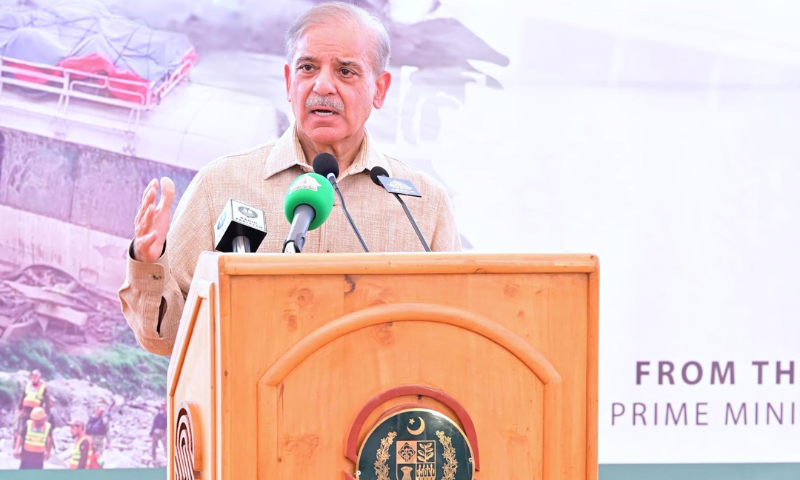
Gilgit, August 4, 2025: Prime Minister Shehbaz Sharif on Monday announced a Rs4 billion relief and reconstruction package for Gilgit-Baltistan (GB) following devastating monsoon rains and flash floods that wreaked havoc across the region. The premier visited flood-affected areas, distributed compensation cheques to bereaved families, and pledged swift rehabilitation efforts.
During his one-day visit, PM Shehbaz handed over Rs1 million cheques to the families of those who lost their lives in the calamity. He offered prayers for the deceased and extended sympathies to the injured, reaffirming the federal government’s commitment to stand by the people of GB during these testing times.
“Pakistan is among the countries worst affected by climate change,” the prime minister said while addressing a compensation distribution ceremony. He stressed the urgent need for an early warning system, lamenting that no significant progress had been made in this area over the past seven years—including the last 15 months of his administration.
“I will seek answers from ministers and secretaries on why this critical work was delayed,” he said, urging all relevant institutions to adopt coordinated, future-proof strategies to mitigate climate disasters.
The prime minister also directed the Minister for Communications to accelerate infrastructure restoration efforts, adding that he would return to the region before the end of August to personally monitor progress. He announced a damage assessment survey to quantify the destruction and expedite rehabilitation.
Key announcements
- A 100-megawatt solar power project will be completed in GB this year.
- A Daanish School will be inaugurated in the upcoming visit, while another will be established in Skardu.
- Relief and infrastructure repair will be treated as top priority, with swift deployment of federal resources.
PM Shehbaz was accompanied by Minister for Communications Abdul Aleem Khan, Information Minister Attaullah Tarar, Minister for Kashmir and GB Affairs Engineer Amir Muqam, Climate Change Minister Dr. Musadik Malik, and Adviser Rana Sanaullah. Upon arrival, he was briefed by GB Governor Mehdi Shah on flood-related damages, ongoing development projects, and the security situation in the region.
The visit comes amid an alarming monsoon season that has caused at least 299 deaths across Pakistan—including 140 children. In GB’s Babusar Valley, a devastating cloudburst last week triggered flash floods that swept away tourists and vehicles, leaving six dead and several missing. In Chilas, Skardu, and surrounding areas, landslides stranded more than 200 tourists, blocking key roads including the Karakoram Highway. Joint rescue operations by the Pakistan Army and civil authorities helped evacuate many of those trapped.
In a grim update, GB government spokesperson Faizullah Faraq confirmed that a 14-day search operation in the flood-hit Babusar Valley has concluded with no survivors or remains found. “Hopes of recovering the missing have now faded,” he said.
Speaking to journalists, the prime minister reiterated that climate change posed a clear and present danger to Pakistan, recalling the catastrophic 2022 floods. He emphasized that the Ministry of Climate Change has been directed to develop comprehensive strategies for mitigation and adaptation.
“Despite contributing almost nothing to global emissions, Pakistan is among the top ten most climate-vulnerable countries,” PM Shehbaz noted. He called for greater international engagement, including proactive participation in upcoming global climate forums to secure funding for resilient infrastructure.
According to the Pakistan Meteorological Department (PMD), another spell of heavy rainfall is forecast to hit GB and Azad Jammu & Kashmir from August 4 to August 7. The July 2025 rainfall was 23% above average, with GB recording 20.2mm, marking a 52% increase over typical July rainfall levels.
Punjab also experienced one of its wettest Julys on record, with 163.5mm of rain, 57% above the monthly norm. July, climatologically the wettest month, contributed 44.9% of annual and 21.3% of seasonal rainfall in Pakistan.