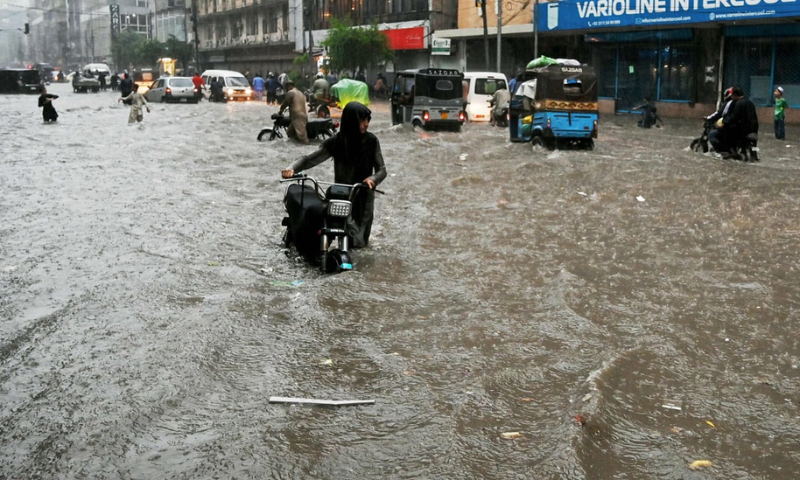
Karachi, August 20, 2025: At least 17 people have died in Karachi as intermittent downpours lashed the city for a second consecutive day, bringing urban flooding, prolonged power outages, and severe disruptions to transport and daily life.
According to the Pakistan Meteorological Department (PMD), Gulshan-e-Hadeed received 178mm of rain and University Road 145mm during the past 24 hours. More monsoon showers, with isolated heavy falls, are forecast for today and tomorrow as strong weather systems from the Arabian Sea and Bay of Bengal continue to impact southern Pakistan.
The torrential rains left major arteries waterlogged, with stranded vehicles and potholes scattered across Karachi. Floodwaters inundated parts of the Old City Area, Aram Bagh, Sindh High Court, Liaquatabad, and University Road, while key roads such as Karsaz and Malir Halt remained partially blocked despite ongoing drainage operations.
Police confirmed that children and a woman were among the victims. In one tragic incident, a 70-year-old disabled man drowned inside his PECHS residence after falling into accumulated rainwater.
The city’s power supply has been badly hit. While K-Electric said over 1,550 of 2,100 feeders had been restored, more than 240 feeders remain down, plunging neighbourhoods such as Gulistan-e-Jauhar, North Nazimabad, Malir, Korangi, Orangi Town, Gadap, PECHS, Gulshan-e-Iqbal, Sultanabad, Moinabad, and DHA into outages, some lasting more than 24 hours. The utility said flooded roads disrupted fuel deliveries and hampered access for repair crews.
The rains also disrupted flight operations at Jinnah International Airport, with several domestic flights cancelled and international flights delayed as airline staff were unable to reach duty stations.
Amid the worsening situation, the Sindh High Court ordered the closure of all courts in Karachi, including the principal seat and subordinate courts.
Karachi Mayor Murtaza Wahab said the city had received over 235mm of rainfall, far exceeding its 40mm drainage capacity, but claimed that most main roads had been cleared. “Drainage efforts are continuing where rainwater has accumulated,” he said, adding that 3.024 million cubic feet of debris had so far been removed from storm drains.
Wahab admitted shortcomings in the city’s drainage infrastructure. “Basic steps are needed to expand drainage capacity, but this requires land and faces resistance from residents, making the task difficult,” he noted.
Despite improvements on main routes, traffic continues to move slowly where water remains pooled on the sides of roads, while complaints of prolonged electricity breakdowns persist across multiple neighbourhoods.