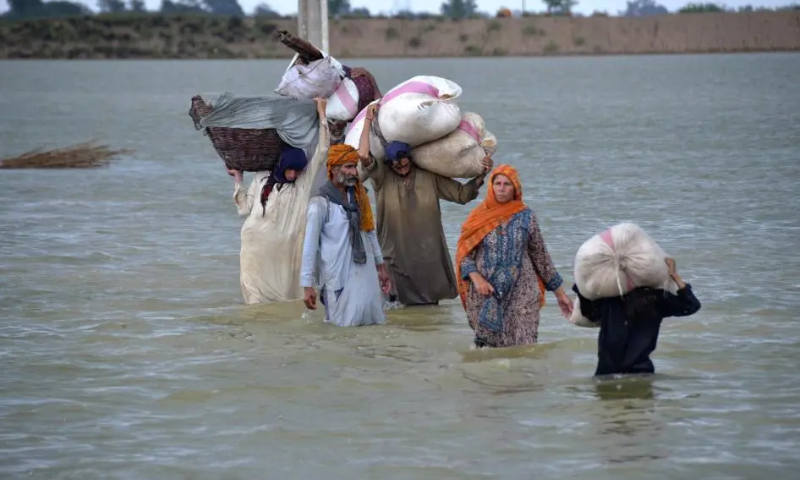
Islamabad, August 28, 2025: Pakistan is facing another wave of flash floods in Khyber Pakhtunkhwa, Gilgit-Baltistan, and Punjab, even as recovery from the catastrophic 2022 deluge remains far from complete.
A Post-Disaster Needs Assessment (PDNA) carried out after the 2022 floods estimated $14.9 billion in losses and $16.3 billion in recovery needs. At the 2023 Geneva conference, international donors pledged $10.9 billion to support reconstruction. Yet, three years later, only around 20% of those commitments have materialised, leaving large parts of the recovery and resilience agenda stalled.
The World Bank has warned that Pakistan requires $348 billion over the next seven years to meet its climate and development challenges. But actual delivery on pledges remains slow and fragmented. Out of the $10.9 billion promised, just $3.4 billion in projects have been executed, mostly through multilateral banks.
The World Bank has rolled out projects worth $2.1 billion, while the Asian Development Bank (ADB) has operationalised roughly a third of its pledged support. The Islamic Development Bank (IsDB), however, has directed most of its $4.2 billion package to commodity financing, leaving only $600 million for flood-related activities. Similarly, the Saudi Fund for Development’s $1 billion pledge was tied to oil imports rather than reconstruction. This reduces effective recovery financing to just $6 billion.
Aid allocation also remains uneven. Agriculture and livelihoods (SRO-2)—the hardest-hit sectors in 2022—have received less than $200 million, or just 4.5% of identified needs. With agriculture employing a major share of Pakistan’s workforce and contributing significantly to GDP, this funding imbalance threatens long-term economic stability.
Bilateral support has been even slower. The Paris Club countries pledged $799 million, but by August 2024 only 14.6% had been disbursed. France and Japan honoured early commitments, but countries like Germany and Italy have yet to deliver meaningful support. Meanwhile, flood-hit districts in Sindh and Balochistan remain underserved.
Officials warn that continued underfunding of recovery efforts, coupled with mounting climate shocks, risks deepening Pakistan’s economic fragility and humanitarian crises. Images of inundated villages, ruined crops, and displaced families once again underscore the urgency for timely aid, climate justice, and accountability from the global community.