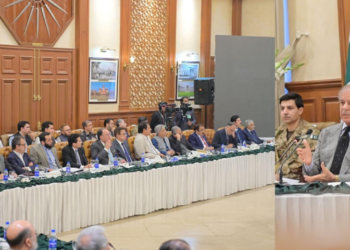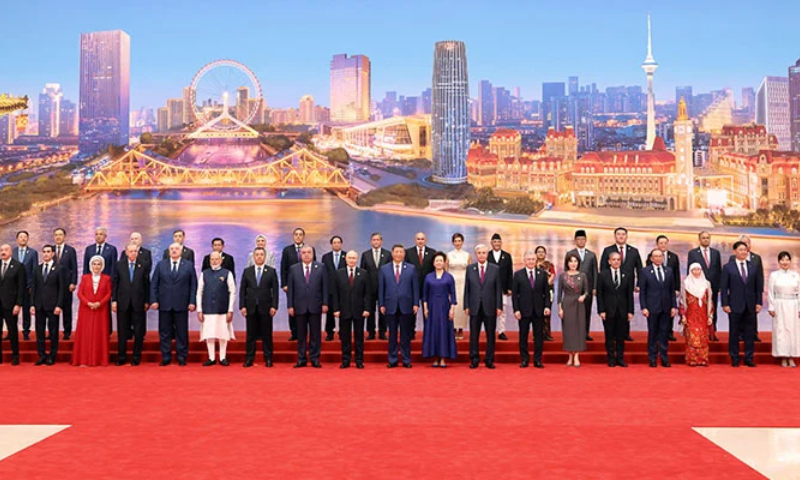
Tianjin, September 1, 2025: Leaders of the Shanghai Cooperation Organisation (SCO) on Monday strongly denounced the recent terrorist incidents in Indian Illegally Occupied Jammu and Kashmir’s (IIOJK) Pahalgam area, on Pakistan’s Jaffar Express, and in Khuzdar, pledging deeper cooperation to counter terrorism in all its forms.
In a joint declaration issued after the Council of Heads of State meeting in Tianjin, member states stressed that the perpetrators, organisers, and sponsors of terrorism must be held accountable. They reaffirmed their collective resolve to fight terrorism, separatism, and extremism, while rejecting the use of militant groups for political or strategic purposes.
The statement followed months of heightened tensions between Pakistan and India after the April 22 Pahalgam attack. New Delhi blamed Islamabad without evidence — allegations Pakistan has denied. The dispute escalated into a four-day armed conflict, during which Pakistan launched Operation Bunyan-um-Marsoos after downing six Indian jets.
The SCO declaration noted that Pakistan recently secured a diplomatic win when the United States formally designated the India-backed Balochistan Liberation Army (BLA) and its militant wing, the Majeed Brigade, as a Foreign Terrorist Organisation (FTO). The BLA, already listed as a Specially Designated Global Terrorist group since 2019, claimed responsibility for the deadly March hijacking of the Jaffar Express that killed 31 people and left hundreds taken hostage.
The SCO leaders also praised the role of the bloc’s Regional Anti-Terrorist Structure (RATS) in facilitating intelligence-sharing and joint drills, including the 2024 “Interaction–Anti-Terror” exercises in China’s Xinjiang region. They adopted a new 2026–2030 Program of Cooperation to counter radical ideologies, religious intolerance, xenophobia, and extremist propaganda.
On wider global issues, the summit condemned Israeli and U.S. strikes on Iran in June that hit civilian and nuclear energy sites, calling them a “gross violation of international law” and a threat to global security. The declaration also reiterated support for a just settlement of the Palestinian question and called for safeguarding the safety of nuclear facilities during armed conflicts.
Chinese President Xi Jinping and Russian President Vladimir Putin used the forum to criticise Western policies. Xi warned that the global situation was becoming “chaotic and intertwined” and urged SCO members to reject “bullying behaviour” and uphold the “Shanghai spirit” of cooperation. He also outlined a Global Governance Initiative (GGI) aimed at strengthening the role of the Global South and reducing reliance on Western-led systems.
Putin defended Russia’s war in Ukraine, accusing the West of provoking the crisis by supporting a coup and attempting to expand NATO eastwards. He praised the SCO as a platform for “genuine multilateralism,” citing increased trade in national currencies as a step toward a new Eurasian security and financial order.
In a significant economic move, Xi proposed establishing an SCO Development Bank and pledged 2 billion yuan ($280 million) in aid and 10 billion yuan in loans for member states this year. He also announced plans for an SCO Artificial Intelligence Cooperation Centre and invited members to join China’s lunar research station.