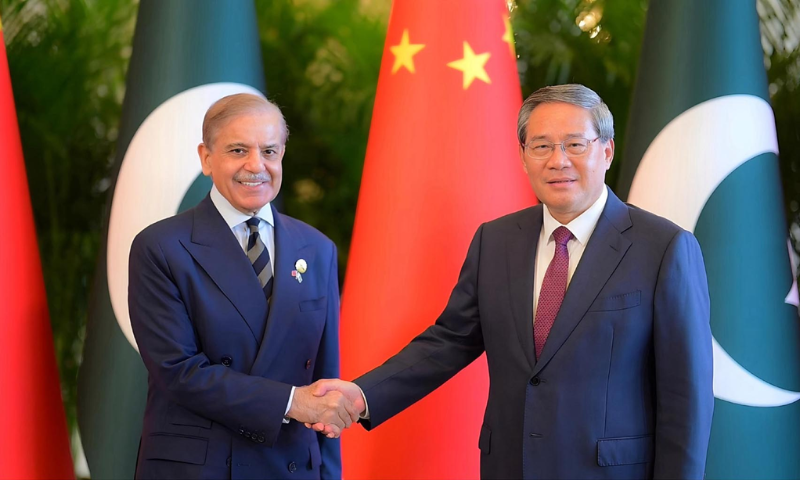
Beijing, September 4, 2025: Prime Minister Shehbaz Sharif and Chinese Premier Li Qiang on Thursday reaffirmed their resolve to advance the second phase of the China-Pakistan Economic Corridor (CPEC-II), focusing on industrial cooperation, infrastructure, and economic reforms.
The meeting, described by PM Shehbaz as “warm and most productive,” took place during his ongoing six-day visit to China, where he earlier attended the Shanghai Cooperation Organisation (SCO) summit in Beijing.
According to a statement by Pakistan’s Press Information Department (PID), both leaders agreed to accelerate work on the upgraded CPEC 2.0 with five new corridors, alongside early implementation of key projects such as the Main Line-1 (ML-1) railway upgrade, Karakoram Highway realignment, and Gwadar Port operationalisation.
PM Shehbaz invited Chinese companies to expand their investment footprint in Pakistan, citing opportunities in agriculture, mining, information technology, textiles, and industry. He said Pakistan would soon float Panda Bonds in the Chinese capital market to strengthen financial cooperation.
“CPEC has played a central role in Pakistan’s socio-economic development over the past decade,” the premier noted, thanking China for its “steadfast support” in bolstering Pakistan’s economy, including the rollover of $3.4 billion in loans in June.
The PID statement confirmed the signing of multiple MoUs and agreements covering CPEC 2.0, science and technology, IT, media, agriculture, and other fields. The two sides also endorsed a Joint Action Plan 2024–2029, which both leaders hailed as a roadmap for deepening bilateral ties.
The discussions built on an earlier meeting between PM Shehbaz and President Xi Jinping on the sidelines of the SCO summit, where both leaders pledged to further strengthen their “iron-clad, all-weather strategic cooperative partnership.” President Xi reiterated China’s support for Pakistan’s development capacity and expressed readiness to upgrade the Free Trade Agreement and expand cooperation in industries, agriculture, and mining.
Business and academic engagements
The prime minister also addressed a Pakistan-China Business-to-Business Investment Conference in Beijing, attended by more than 300 Pakistani and 500 Chinese companies. He underlined the potential for industrial relocation into Pakistan’s special economic zones, highlighting the country’s “unique comparative advantage” in skilled labour, cost-effective inputs, and regional connectivity.
In a meeting with Chinese Minister for IT and Industry Li Lecheng, the premier reiterated Pakistan’s vision of closer cooperation in ICT, agriculture, mining, and trade. Minister Li praised Pakistan’s reform agenda and reaffirmed China’s resolve to elevate ties to “new heights of cooperation.”
PM Shehbaz also highlighted Pakistan’s academic linkages with China, noting that 1,000 agriculture graduates from Pakistan are currently training in China and that about 30,000 Pakistani students are pursuing education across Chinese universities.
Both sides agreed to celebrate the 75th anniversary of diplomatic relations next year with high-level exchanges and new initiatives under CPEC-II.
“Inspired by President Xi Jinping’s visionary leadership, we remain committed to building a stronger Pakistan-China community with a shared future,” PM Shehbaz said in a post on X.