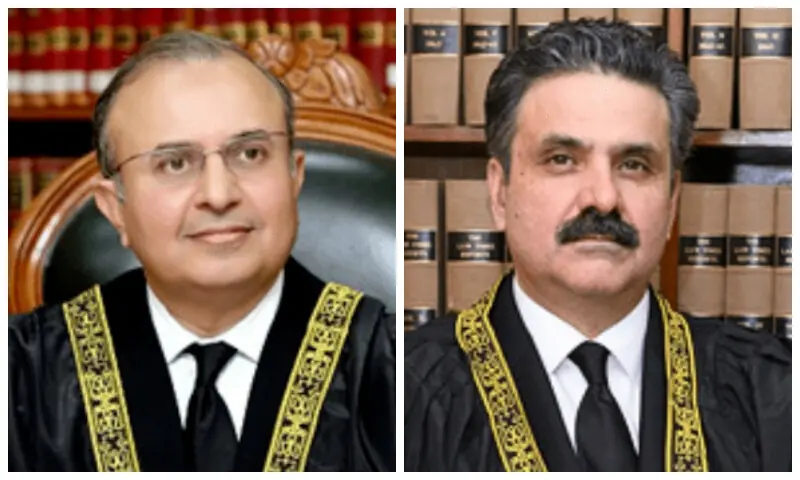
Islamabad, September 5, 2025: Supreme Court Justice Mansoor Ali Shah has written a strongly worded letter to Chief Justice of Pakistan (CJP) Yahya Afridi, urging him to publicly answer six questions relating to what he termed “pressing institutional concerns” of the apex court.
In the letter dated September 4, Justice Shah said he was compelled to write due to the CJP’s “persistent and complete indifference” to earlier communications. He noted that his repeated letters on critical matters had “gone unanswered and undiscussed,” calling such silence “not merely discourteous” but damaging to collegial traditions of the court.
The senior puisne judge stressed that with the new judicial year beginning Monday and a judicial conference scheduled under CJP Afridi’s leadership, the forum should be used to respond openly to the concerns in front of judges, the bar, and the public.
Justice Shah asked CJP Afridi to clarify:
- Why has the Practice and Procedure Act Committee never been convened?
- Why was the revision of Supreme Court Rules 1980 approved through circulation rather than a Full Court discussion?
- Why was the policy on dissenting opinions adopted through written solicitations instead of open deliberations?
- Why was a General Standing Order (GSO) on leave issued that curtails judicial independence?
- Why are the petitions against the 26th Amendment still pending before the original Full Court?
- Whether the CJP is promoting judicial independence or “enforcing compliance to turn this court into a regimented force.”
Justice Shah criticised unilateral bench formations, arguing that the Supreme Court (Practice and Procedure) Act, 2023 was enacted to end the “one-man show” in bench-making. He said no formal meeting of the PaPA Committee had been convened since CJP Afridi’s appointment in October 2024, and rosters were circulated without deliberation.
“Independent judges are being sidelined … not for efficiency but for control,” he wrote, adding that despite the increase in the number of judges, case pendency still stands at 57,455, defeating the purpose of expansion.
He called the circulation-based approval of the revised Supreme Court Rules “a historic but squandered opportunity” to build collective wisdom, while labelling the registrar-led process of gathering judges’ written views on dissenting opinions as a “secretive tick-box exercise.”
“A Full Court meeting is not merely procedural—it is the bedrock of judicial collegiality,” he stressed.
Justice Shah termed the July 29 GSO “wholly alien” to a constitutional court, arguing it reduced judges to “supervised functionaries.” He opposed requirements for judges to disclose personal addresses, describing it as “surveillance, not administration.”
“Judges are guardians of liberties, not regimented officers. A judiciary under watch ceases to be a judiciary,” he warned.
The judge said the Supreme Court’s legitimacy itself “hangs in the balance” due to the unexplained delay in hearing petitions against the 26th Amendment, which he argued should be fixed before the original Full Court.
Justice Shah emphasised that his concerns were not personal grievances but institutional responsibilities. He urged the CJP to use the judicial conference as a “moment of renewal” by addressing the issues with clarity, transparency, and fidelity to the Constitution.
“The nation looks to you, not for silence, but for clarity,” the letter concluded.