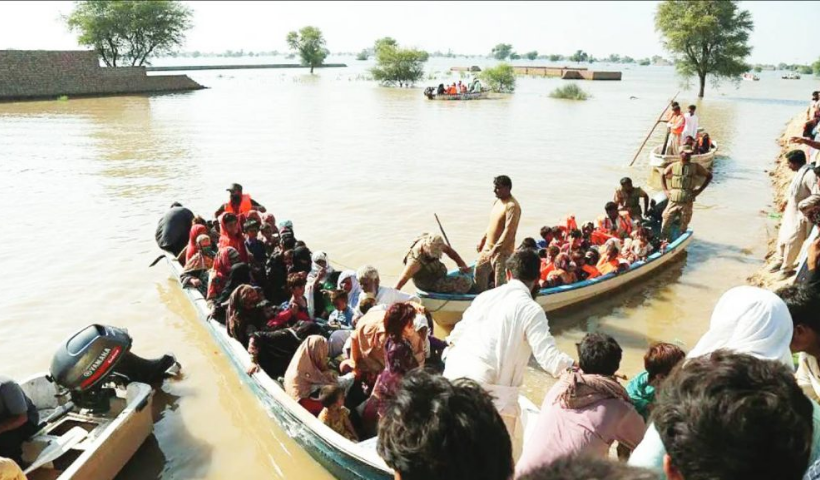
Karachi/Islamabad, September 16, 2025: Authorities in Pakistan’s eastern Punjab province said on Tuesday they had launched a survey to assess damages caused by devastating floods, as the official death toll in the province from the latest spell of monsoon deluges rose to 112.
Heavy rains combined with excess water released from Indian dams last month swelled Punjab’s rivers, inundating more than 4,700 villages across the agricultural heartland. Crops and homes were destroyed, millions were displaced, and large-scale relief operations were launched.
According to the National Disaster Management Authority (NDMA), Punjab has reported 290 deaths since the monsoon season began on June 26, out of a nationwide total of 992. Other casualties include 504 in Khyber Pakhtunkhwa, 80 in Sindh, 41 in Gilgit-Baltistan, 38 in Azad Kashmir, 30 in Balochistan, and nine in Islamabad.
Punjab Relief Commissioner Nabeel Javed said the government was committed to compensating losses. “A survey has been initiated to assess the damages caused by the floods,” he told reporters, adding that 4.72 million people had been affected. So far, 363 relief camps and 446 medical camps have been established, while 2.6 million people have been relocated to safer areas.
The Punjab Disaster Management Authority reported steady or receding water levels on the Ravi, Chenab, and Sutlej rivers as of September 16. At key headworks, the Chenab stood at 66,381 cusecs at Marala, 66,422 at Khanki, and 78,756 at Trimmu. The Ravi recorded moderate flows of around 10,000–27,000 cusecs at various points, while the Sutlej remained high but stable, peaking at 90,547 cusecs at Sulemanki.
At Panjnad Headworks, where Punjab’s five rivers merge into the Indus, inflows reached 234,755 cusecs. Further downstream, Sindh’s Guddu Barrage recorded 609,137 cusecs, while Sukkur Barrage remained in “high flood” at 502,667 cusecs. Kotri Barrage eased into the “medium flood” range at 293,000 cusecs, though officials warned high levels would persist at Sukkur for several more days.
Authorities have also sounded alarms over a looming dengue outbreak as stagnant floodwaters create ideal breeding conditions for mosquitoes.
In a Sept. 15 advisory, the Pakistan Meteorological Department warned that hot, humid weather coupled with waterlogging posed an “unprecedentedly high risk” of dengue outbreaks beginning September 20. Ten major cities, including Karachi, Lahore, Islamabad, Faisalabad, Sialkot, Rawalpindi, Peshawar, Sukkur, Hyderabad, and Multan, as well as rural districts, were flagged as high-risk areas.
Dengue is a mosquito-borne viral infection that can cause severe illness and death. Officials fear that lingering floodwaters and poor drainage could worsen the crisis in both urban and rural regions.
Despite contributing less than one percent of global greenhouse gas emissions, Pakistan is among the most climate-vulnerable countries. In 2022, catastrophic floods submerged one-third of the country, killed nearly 1,700 people, and caused damages exceeding $30 billion.
Experts warn that erratic rainfall patterns, driven by climate change and accelerated glacial melt, continue to heighten flood risks, leaving millions vulnerable each monsoon season.