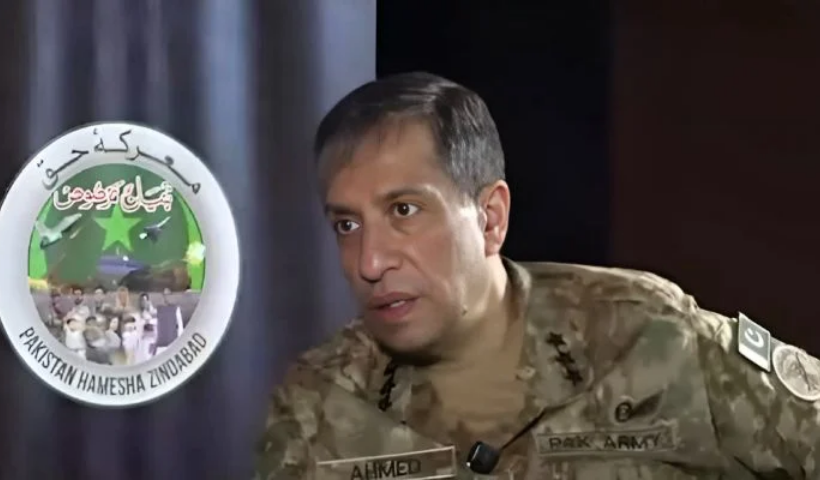
Rawalpindi, September 19, 2025: Pakistan’s military has accused India of allowing extremist political ideologies to dominate its state institutions, including the Indian Army, warning that this poses a serious threat to regional peace.
In an interview with a German news outlet on September 5, Director General Inter-Services Public Relations (ISPR) Lieutenant General Ahmed Sharif Chaudhry said that despite the ceasefire between Pakistan and India, the underlying disputes remain unresolved.
“The conflicts endure. Whether it’s the Kashmir issue, India’s state-sponsored terrorism, or the rise of Hindutva extremism, all of these continue to fuel tensions,” he said. “It is important that international players, especially the US, intervene to help resolve these enduring disputes.”
Lt Gen Chaudhry dismissed the notion of “insurgency” in Pakistan, stating that violence in Balochistan and Khyber Pakhtunkhwa is “pure terrorism” directly sponsored by India.
“The correct term is not insurgents, it’s terrorists. Every terror incident inside Pakistan has Indian support behind it,” he asserted.
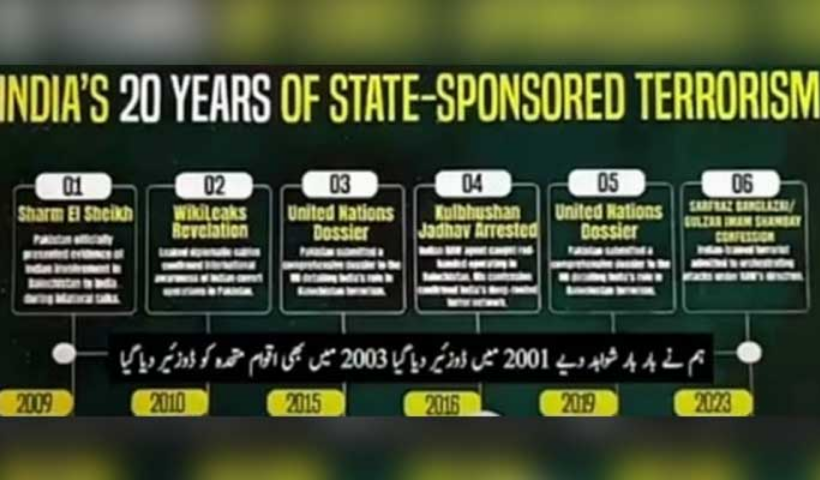
He recalled that Pakistan has presented at least six dossiers to the international community between 2009 and 2023, providing evidence of India’s involvement in terrorism.
Highlighting Pakistan’s counterterrorism efforts, the ISPR chief revealed that law enforcement agencies have conducted nearly 47,900 intelligence-based operations (IBOs) this year alone. These operations resulted in the elimination of over 1,000 terrorists, while 762 people, including nearly 300 civilians, embraced martyrdom.
“If this terrorism was only homegrown, it would have ended long ago. The scale of attacks makes it clear there is external, sustained support, with Afghanistan serving as the base of operations for Indian-backed groups like the BLA and TTP,” he added.
Asked why Western nations have not endorsed Pakistan’s stance, Lt Gen Chaudhry pointed to New Delhi’s vast disinformation machinery and its strong economic ties with the West.
“The West needs to accept India as a terror-sponsoring state. At the same time, they view India as a ‘net security provider’ and an economic partner, which clouds their perspective,” he remarked.
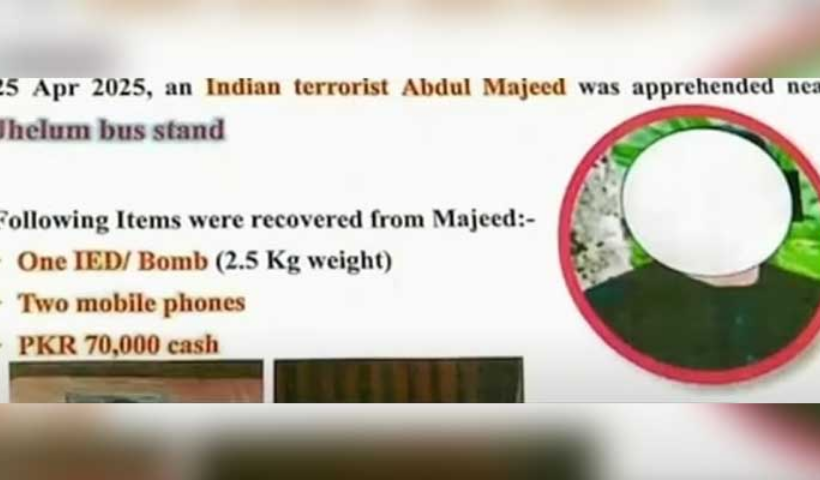
Responding to accusations that Pakistan harbors militant groups, the ISPR chief dismissed them as propaganda. “This is part of India’s disinformation campaign. They commit terrorism and then blame Pakistan for it,” he said.
Lt Gen Chaudhry also raised concerns about the massive cache of Western weapons left in Afghanistan after the US and NATO withdrawal. Citing a SIGAR report, he said equipment worth $7.2 billion was abandoned, much of which is now in the hands of militant groups.
“These non-state actors are not only a threat to Pakistan but to the region and the world at large,” he warned.
Rejecting claims that Pakistan sponsors groups like Lashkar-e-Taiba (LeT) or Jaish-e-Mohammad (JeM), the ISPR DG said:
“Pakistan has never had a policy of sponsoring terrorism. We believe a terrorist has no religion. There is no space for private militias or armies in our country.”
On Pakistan’s relations with Washington, Lt Gen Chaudhry emphasized that Islamabad does not view its ties with the US and China in “either-or” terms.
“Pakistan and the US have a longstanding relationship. We have managed our divergences and enhanced our convergences, especially in counterterrorism and intelligence sharing,” he said, thanking Washington for declaring the Majeed Brigade a terrorist outfit.
Turning to India, the ISPR chief said New Delhi seeks to “externalize its internal problems,” particularly the oppression of minorities and the situation in Indian Illegally Occupied Jammu and Kashmir (IIOJK).
“With over one million Indian troops deployed in IIOJK, every household can be searched at any time. Instead of addressing internal repression, India blames Pakistan,” he added.
Addressing the issue of missing persons, Lt Gen Chaudhry said many of them were linked to militant groups. He cited the Commission of Inquiry on Enforced Disappearances, which reported 10,405 cases since its formation. Out of these, 8,144 cases were resolved, 2,261 are under investigation, and 452 remain pending.
“There are actually more missing persons cases in Sindh and Punjab than in Balochistan,” he noted.