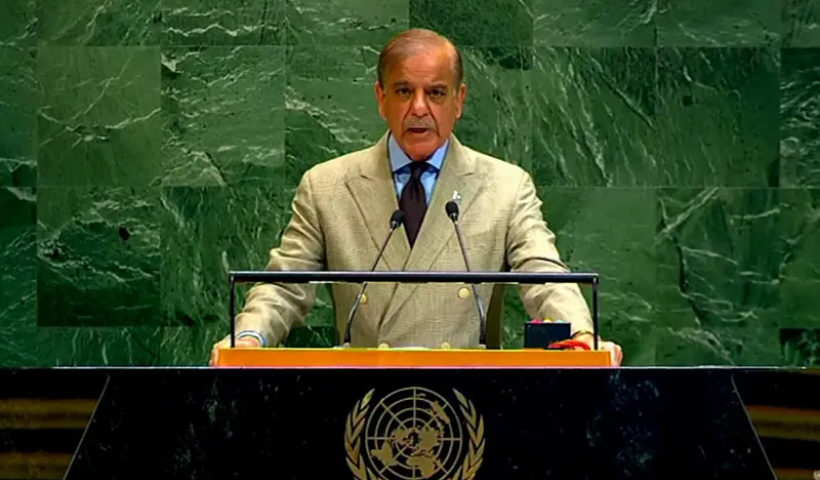
United Nations, September 26, 2025: Prime Minister Shehbaz Sharif on Friday declared before the United Nations General Assembly (UNGA) that Pakistan had “won the war” against India during the May confrontation and urged for “proactive rather than provocative leadership” to ensure peace in South Asia.
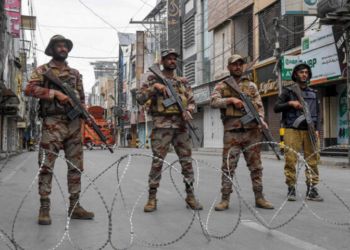
Addressing the 80th UNGA session, the prime minister recalled the week-long escalation in May, triggered by Indian air strikes on Pakistani territory following the April 22 Pahalgam attack. The clashes, which included cross-border missile exchanges, ended only after U.S.-brokered diplomacy.
“Our enemy came shrouded in arrogance, and we sent them back in humiliation,” Shehbaz told the Assembly, praising Pakistan’s armed forces under Field Marshal Asim Munir and Air Chief Marshal Zaheer Babar Sidhu for their “professionalism and bravery.” He claimed seven Indian jets were downed during the exchanges.
The premier said Pakistan agreed to a ceasefire “from a position of strength,” while thanking U.S. President Donald Trump for his “decisive efforts” in averting a full-scale war. He announced that Pakistan had nominated Trump for the Nobel Peace Prize, describing him as a “man of peace.”
Shehbaz also extended gratitude to China, Turkiye, Saudi Arabia, Qatar, Azerbaijan, Iran, the UAE, and UN Secretary-General António Guterres for diplomatic support during the crisis.
Kashmir, Indus Waters dispute
The prime minister reiterated Pakistan’s demand for a UN-backed plebiscite in Kashmir and denounced India’s suspension of the Indus Waters Treaty, warning that Islamabad would “ardently defend” its rights over the river system for its 240 million people.
Palestine and Gaza
Turning to Gaza, Shehbaz called the situation “one of the most heart-wrenching tragedies of our time,” accusing Israel of committing genocide. “The smallest coffins are the heaviest to carry,” he said, recalling the funeral of a six-year-old Pakistani child killed during the May conflict. He reaffirmed Pakistan’s support for a sovereign Palestinian state based on pre-1967 borders with Jerusalem as its capital.
The premier welcomed recent recognitions of Palestine and praised President Trump’s initiative earlier this week to convene Muslim leaders on Gaza, saying he hoped it would rekindle efforts toward a ceasefire. He also condemned an Israeli strike in Doha targeting Hamas leaders and expressed solidarity with Qatar.
Regional peace and terrorism
Shehbaz said Pakistan condemned terrorism in all forms, highlighting the country’s two-decade-long sacrifices in the global fight. He accused “foreign-funded groups” operating from Afghanistan of carrying out cross-border terrorism and called on Kabul’s interim government to ensure its soil is not used against any country.
“Had these terrorists not been encountered by us, they would have been roaming the streets of New York and London,” he warned.
Islamophobia and extremism
The premier cautioned against rising Islamophobia, specifically linking it to “Hindutva-driven extremism in India.” He welcomed the UN’s appointment of a special envoy to combat the scourge.
Climate change
Calling climate change a matter of “urgent collective action,” Shehbaz highlighted Pakistan’s vulnerability, citing the devastating floods of 2022 and 2025. He criticised the global financing model that pushes climate-affected countries into debt: “We are told to take loans and add to our debt. This is not justice. We would be better off standing on our own feet.”
Concluding, Shehbaz said Pakistan “will always stand for peace, justice and development,” urging nations to use the UN’s 80th anniversary to chart a future of fairness and inclusivity.