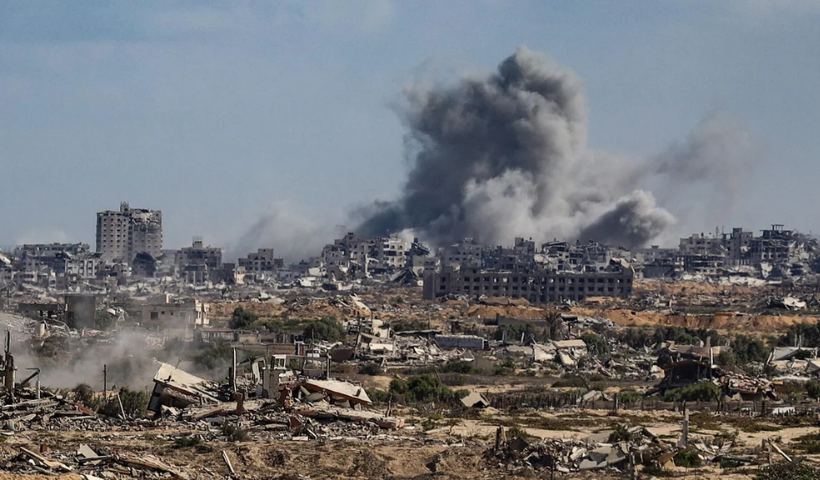
Doha/Gaza, October 7, 2025: Qatar’s foreign ministry on Tuesday said Israel should have already halted its military operations in Gaza in line with U.S. President Donald Trump’s peace plan, as indirect negotiations between Israel and Palestinian groups continued in Egypt.
“Regarding the ceasefire, this question should first be directed to the Israeli occupation government. It was supposed to actually cease fire if the statements made by the prime minister there regarding adherence to the Trump plan were true,” Foreign Ministry spokesman Majed al-Ansari told reporters in Doha.
Ansari said Qatar remained “cautiously optimistic” about the Egyptian-hosted peace talks but noted that “many details” still needed to be worked out.
“I have no doubt that this round of negotiations is one in which all parties are strongly committed to reaching a consensus,” he said. “But the plan’s clauses require practical interpretation on the ground, which of course requires communication with all parties.”
The spokesman said it was “too early” to discuss the future of Hamas’s political bureau in Doha, following last month’s Israeli strike targeting the group’s leadership in the Qatari capital.
“As long as there is a need for a channel of communication with Hamas, there is a need for this,” he said, referring to Qatar’s mediating role — which has continued with U.S. approval.
Meanwhile, a senior Hamas official, Fawzi Barhoum, reiterated that the group’s October 7 attack on Israel was a “historic response” to attempts to eliminate the Palestinian cause.
“We reaffirm that the Al-Aqsa Flood on October 7 was a historic response to efforts to eradicate the Palestinian cause,” Barhoum said in a televised statement.
Barhoum added that Hamas’s delegation in Egypt was “working to overcome all obstacles” in pursuit of an agreement that would meet “the aspirations of our people in Gaza.”
The Palestinian Health Ministry in Gaza reported worsening humanitarian conditions, saying that 25 of the enclave’s 38 hospitals are now out of service, while the remainder are operating only partially under severe shortages.
It said 103 of 157 primary healthcare centers have been destroyed, with the rest functioning intermittently. Over half of essential medicines are unavailable, while 66 percent of required medical equipment is missing.
Hospital bed occupancy has surged to 225 percent by the end of September, compared with 82 percent during the same period last year, according to the ministry.