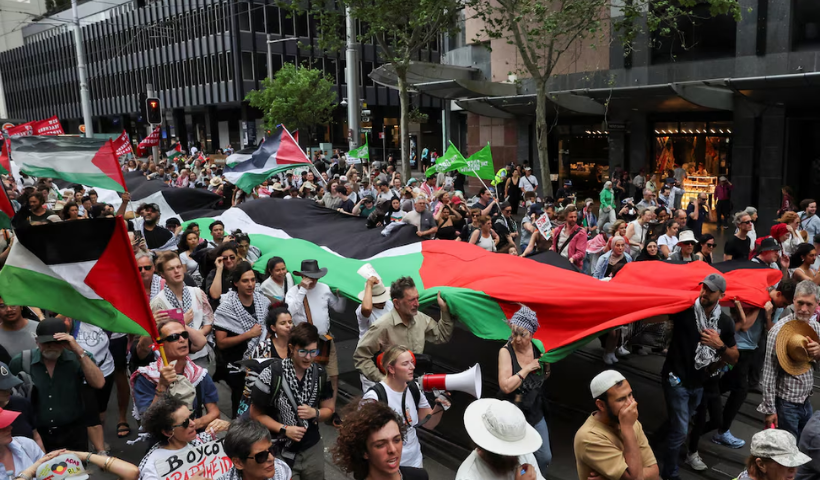
Sydney, October 12, 2025: Tens of thousands of people took to the streets of Sydney and other cities across Australia on Sunday in solidarity with Palestinians, as pro-Palestinian demonstrations continued worldwide amid cautious optimism over a fragile Gaza ceasefire.
Organisers said around 30,000 people joined the rally in Sydney’s central business district, defying a recent court order that barred them from gathering near the Sydney Opera House. Similar protests were held in Melbourne and other Australian cities, as part of a coordinated day of action.
The rallies came as Israeli forces began withdrawing under the first phase of a U.S.-brokered agreement aimed at ending the nearly two-year-long Gaza war, which has killed tens of thousands and devastated the enclave.
“Even if the ceasefire holds, Israel is still conducting a military occupation of Gaza and the West Bank,” said Amal Naser, one of the Sydney organisers, calling the situation an “apartheid system” against Palestinians.
Footage from the Australian Broadcasting Corporation showed streets filled with protesters waving Palestinian flags and wearing keffiyehs. Police reported no arrests.
However, the Executive Council of Australian Jewry, representing over 200 Jewish organisations, criticised the rallies. “They want the deal to fail, which would mean the war would continue,” said co-chief executive Peter Wertheim.
Since the Gaza conflict began on October 7, 2023, large pro-Palestinian marches have become a regular feature in Sydney and Melbourne, often drawing tens of thousands.
Across Europe, massive rallies echoed similar sentiments. In London, tens of thousands filled the streets chanting “Free Palestine” and carrying banners reading “Stop the genocide” and “Stop starving Gaza.”
Ben Jamal, director of the Palestine Solidarity Campaign, said demonstrators were relieved by the ceasefire but remained wary. “We’re sharing the relief of the Palestinian people—but also their fear that this ceasefire will not hold,” he said.
The River Thames embankment turned into a sea of red, white, black, and green — the colours of the Palestinian flag — as the march moved toward Whitehall, where minor scuffles broke out between pro-Palestinian and pro-Israel demonstrators.
In Berlin, about 5,500 protesters joined a largely peaceful rally, significantly smaller than the 60,000-strong march held two weeks earlier. Demonstrators accused Germany’s government of “being on the wrong side of history.”
Meanwhile, in Bern, Switzerland, clashes erupted after 2,000 people joined an unauthorised protest. Police used tear gas and water cannon to disperse demonstrators throwing fireworks.
“We want to show there are still eyes on Gaza, even during this ceasefire,” said Katrina Scales, a 23-year-old student at the Sydney protest. “A ceasefire is not enough.”
Steve Headley, a British trade unionist, echoed that sentiment: “Hopefully this is the first step toward peace—but we’ve been here before.”
For Miranda Finch, 74, who marched in London under the banner “Descendants of Holocaust survivors against Gaza genocide,” the truce offered little comfort. “The Palestinians are going back to less than nothing — rubble on top of bodies,” she said.
The war began after Hamas’s deadly October 7, 2023 attack on Israel that killed 1,219 people, mostly civilians, according to official Israeli figures. Israel’s retaliatory campaign has since killed at least 67,682 Palestinians, mostly civilians, according to the Gaza Health Ministry — figures the United Nations deems credible.
The UN has declared famine conditions in parts of Gaza as humanitarian agencies struggle to deliver aid.
Despite the ceasefire, protesters across continents said they would continue to mobilise until “a lasting peace and justice for Palestinians” is achieved.
“Hopefully it’s one of the last times we have to come out,” said Fabio Capogreco, a Sydney bar manager marching with his family. “But it’s too early to say everything is okay.”