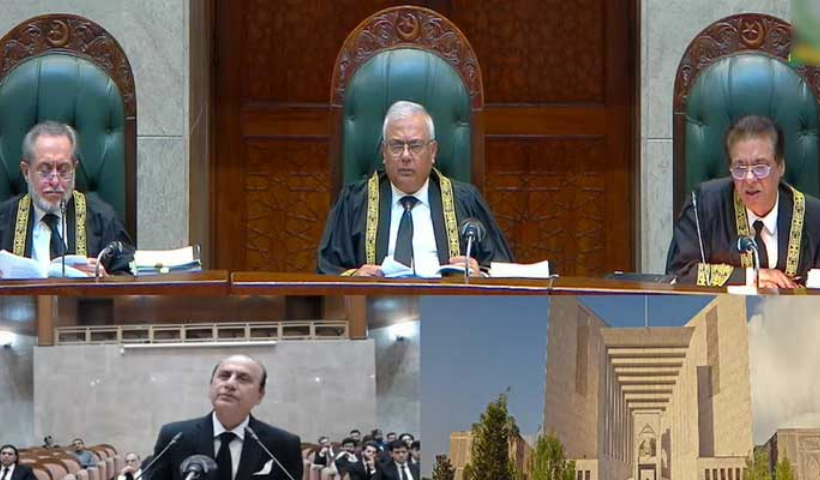
Islamabad, October 21, 2025: Supreme Court Justice Muhammad Ali Mazhar on Tuesday cited the example of India’s judiciary as the top court continued hearings on petitions challenging the 26th Constitutional Amendment, which created a Constitutional Bench (CB) within the apex court.
The eight-member bench, headed by Justice Amin-ud-Din Khan, heard arguments from multiple petitioners questioning the legality and scope of the amendment. The bench also includes Justices Jamal Khan Mandokhail, Ayesha A. Malik, Syed Hassan Azhar Rizvi, Musarrat Hilali, Naeem Akhtar Afghan, Shahid Bilal Hassan, and Muhammad Ali Mazhar.
During proceedings, lawyer Shabbar Raza Rizvi argued that India was the only country with a Constitutional Bench, whereas other nations had separate Constitutional Courts. Justice Mazhar responded, “In India too, the Constitutional Bench has special powers,” adding that the neighbouring country’s Chief Justice acts as the Master of the Roster — a power distributed among two committees in Pakistan.
Justice Mazhar observed, “In Pakistan, the Chief Justice is not the Master of the Roster,” noting a key structural difference between the two judiciaries.
Rizvi contended that the 26th Amendment allowed the Supreme Court to retain its constitutional powers under a proviso. However, Justice Mazhar remarked that the powers under Article 184(3) — concerning the court’s original jurisdiction in matters of public importance — had now been transferred to the Constitutional Bench through Article 191-A.
“Regular and constitutional benches are two branches of the same tree; their powers are separate,” Justice Mazhar observed.
Justice Musarrat Hilali questioned whether the petitioners were seeking suspension of the 26th Amendment, noting that the CB had already been formed. “How will we bypass Article 191-A?” she asked.
Rizvi replied that the article should be read alongside other constitutional provisions and “could not be read alone.”
Responding to the counsel’s suggestion that the bench could direct the formation of a full court, Justice Amin-ud-Din questioned the logic of such a move.
“How can judges who do not have the authority to interpret the Constitution be included in the bench?” he asked. “How can a Constitutional Bench give authority to judges from whom the Constitution has taken it?”
Barrister Adnan Khan, representing another petitioner, Anas Ahmed, later argued that there was no bar on convening a full court to hear the constitutional petitions.
“A full court is not formed, my lord — it is always present; it is just summoned,” he said.
When asked by Justice Hilali whether the matter should be sent to the Chief Justice, Barrister Khan responded that the Chief Justice could summon the full court if deemed appropriate.
Justice Mazhar further inquired how the Chief Justice could nominate judges when he was already a member of the Judicial Commission of Pakistan (JCP).
The petitions have been filed by around three dozen parties, including the Pakistan Tehreek-e-Insaf (PTI), Jamaat-e-Islami (JI), Sunni Ittehad Council (SIC), Lahore High Court Bar Association, Karachi Bar Association, and seven former presidents of the Supreme Court Bar Association (SCBA), as well as several individuals.
After hearing the arguments, the court adjourned the hearing till Wednesday (tomorrow).