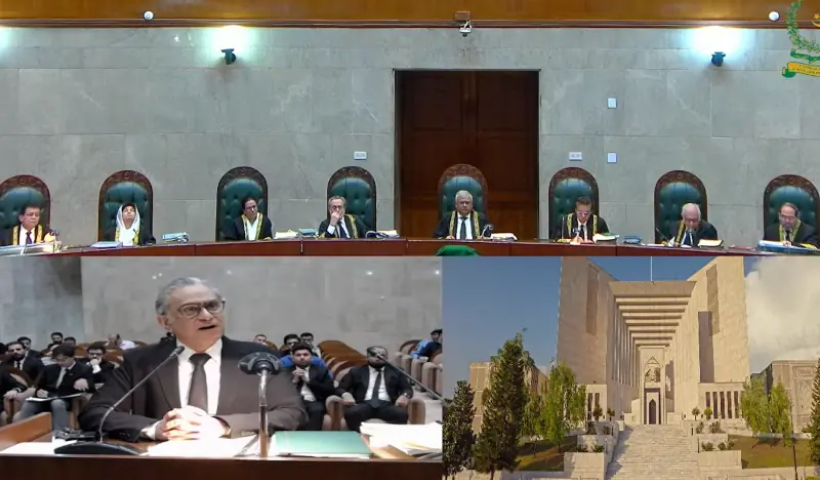
Islamabad, October 22, 2025: Justice Ayesha A. Malik on Wednesday observed that there was no restriction on a full Supreme Court hearing a case fixed before the Constitutional Bench (CB) under Article 191A, introduced through the 26th Constitutional Amendment.
She made the remarks during proceedings of an eight-member Constitutional Bench hearing over three dozen petitions challenging the 26th Amendment, which was passed by Parliament during an overnight session in October last year. The amendment altered judicial powers and tenure, limiting the Supreme Court’s suo motu authority, fixing the chief justice’s term at three years, and creating a Special Parliamentary Committee to appoint the chief justice from among the three most senior judges.
The bench, headed by Justice Aminuddin Khan, includes Justices Ayesha Malik, Mohammad Ali Mazhar, Jamal Khan Mandokhail, Syed Hasan Azhar Rizvi, Musarrat Hilali, Naeem Akhtar Afghan, and Shahid Bilal Hassan.
During Wednesday’s hearing, Advocate Khwaja Ahmad Hosain, representing veteran politician Afrasiab Khattak, argued that the judiciary’s reputation “does not depend on the 26th Constitutional Amendment” and urged that the matter be heard by an “independent full court.”
Justice Mandokhail questioned whether the counsel did not trust the current bench, while Justice Ayesha clarified that Article 191A should not be interpreted as an ouster clause preventing a full court from hearing such matters. She described Article 191A as “procedural” and observed that it restricts benches, not the Supreme Court itself.
“For some reason, we keep reading this as an ouster to say that no one else will hear the case. It simply says no other bench will do it,” Justice Ayesha remarked. “I don’t see a bar,” she added, noting that the Judicial Commission of Pakistan (JCP) nominates judges for the CB under the new provision.
Justice Mazhar expressed agreement with the counsel’s argument that a 16-member bench would constitute a “regular” full court rather than a constitutional bench.
Hosain contended that the CB retained the authority to refer the case to a full court, asserting, “Your lordships have the power. Please do not underestimate your power.” He concluded his arguments before the bench adjourned the hearing till Thursday (October 23).
So far, senior lawyers Hamid Khan, Munir A. Malik, Barrister Salahuddin Ahmed, and Abid Shahid Zuberi have requested the formation of a full 16-member bench to hear the case, reflecting the Supreme Court’s composition in October 2024 when the amendment was passed.
The 26th Amendment has drawn strong criticism from opposition parties, bar councils, and legal experts, who argue that it undermines the judiciary’s independence. Petitioners — including bar associations, the PTI, and political figures — have asked the apex court to strike down the amendment for procedural impropriety or, alternatively, nullify specific clauses relating to judicial appointments, performance evaluations, and the establishment of constitutional benches.
The live-streamed proceedings, ongoing since October 8, will first determine whether the case should be heard by a full court of all available Supreme Court judges or continue before the present eight-member Constitutional Bench.