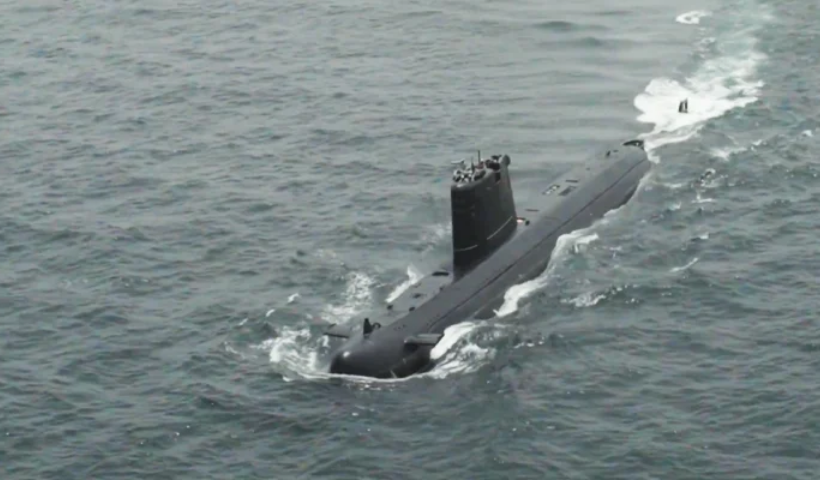
Islamabad, November 3, 2025: The Pakistan Navy expects to induct its first Chinese-designed Hangor-class submarine into active service next year, a move seen as strengthening Beijing’s regional influence and Pakistan’s maritime capabilities in the North Arabian Sea and Indian Ocean.
Admiral Naveed Ashraf, Chief of Naval Staff, told China’s Global Times in an interview published Sunday that the deal for eight Hangor-class submarines, to be delivered by 2028, was “progressing smoothly.” He said the advanced diesel-electric submarines would “enhance Pakistan’s maritime security and operational reach.”
Under the agreement — reportedly valued at up to $5 billion — the first four submarines are being built in China, while the remaining four will be constructed in Pakistan to boost local shipbuilding capacity. Pakistan has already launched three of the submarines from a shipyard along the Yangtze River in China’s Hubei province.
“Chinese-origin platforms and equipment have been reliable, technologically advanced, and well-suited to Pakistan Navy’s operational requirements,” Admiral Ashraf was quoted as saying. He added that the Navy was increasingly focused on emerging technologies, including artificial intelligence (AI), unmanned systems, and advanced electronic warfare, and was exploring collaboration with China in these areas.
The update on the submarine program follows Pakistan Air Force’s use of Chinese-made J-10 fighter jets in May during an aerial clash with the Indian Air Force, in which several French-built Rafale jets were reportedly shot down — an incident that surprised many military analysts and sparked debate about the performance of Chinese versus Western weapon systems.
Islamabad has long been one of Beijing’s closest defence partners and remains its largest arms customer. Between 2020 and 2024, Pakistan accounted for over 60% of China’s total weapons exports, according to data from the Stockholm International Peace Research Institute (SIPRI).
Beijing’s growing defence and economic footprint in Pakistan extends beyond arms sales. Through the China-Pakistan Economic Corridor (CPEC) — a $60 billion network of infrastructure projects — China has gained access to the deep-water port of Gwadar on the Arabian Sea. The corridor stretches more than 3,000 kilometres from China’s Xinjiang region to the Pakistani coast, offering Beijing a direct route for Middle Eastern energy imports and trade, bypassing the Strait of Malacca, a key maritime chokepoint.
“This cooperation with China goes beyond hardware; it reflects a shared strategic outlook, mutual trust, and a long-standing partnership,” Admiral Ashraf said. “In the coming decade, we expect this relationship to expand, encompassing shipbuilding, training, interoperability, research, and industrial collaboration.”