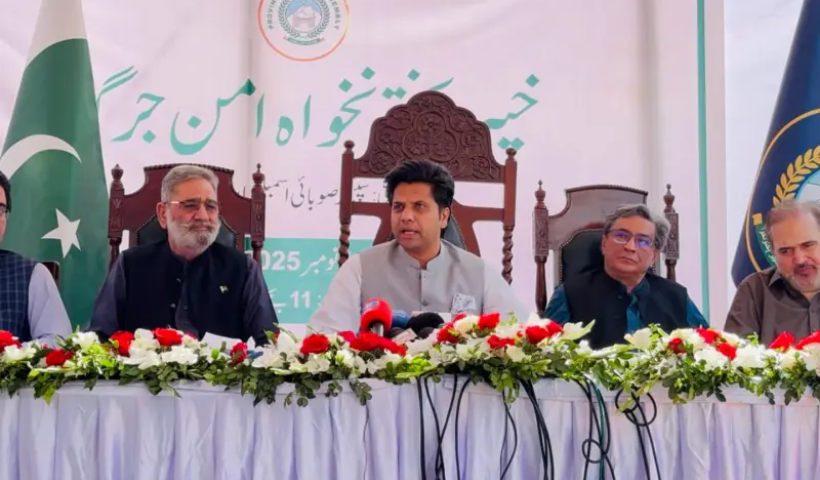
Peshawar, November 6, 2025: Special Assistant to the Khyber Pakhtunkhwa (KP) Chief Minister on Information and Public Relations Shafiullah Jan said on Thursday that only the provincial chief executive has the authority to make decisions aimed at ensuring lasting peace in the province.
“We have the mandate. Any decision for lasting peace in the province will be made by the chief minister, and the provincial government will implement it,” Jan told a news conference in Peshawar.
He said that law and order remained the biggest challenge for the provincial government, adding that steps were being taken to address the issue comprehensively.
Jan also announced that a multi-party conference (MPC) would be held next week to formulate a collective strategy for peace.
“The finalised terms of reference (ToRs) will be presented to the chief minister for further discussion with stakeholders to decide the future course of action,” he said.
Meanwhile, PTI Provincial Secretary General Ali Asghar called on all political parties to submit their proposals ahead of the MPC, reiterating the PTI’s stance against military operations in KP.
“The consequences of military operations are faced by the locals who vacate their homes,” he said, recalling that PTI founder Imran Khan has consistently opposed any new operations in the province.
The PTI has been vocal in rejecting federal plans to launch anti-terror operations in KP. In August, while imprisoned, Imran Khan had directed then–Chief Minister Ali Amin Gandapur not to allow the Centre to carry out such actions.
However, Gandapur later diverged from that line, defending the use of mortar shells, drones, and fighter jets against terrorists as part of the military’s constitutional mandate. His stance led to a rift within the party, prompting Imran Khan to replace him with Shah Farman Afridi, who was elected KP chief minister on October 13.
The change in KP’s leadership came just days after Director General Inter-Services Public Relations (DG ISPR) Lt Gen Ahmed Sharif Chaudhry held a press conference at Peshawar Corps Headquarters. Responding to a question about negotiations with the banned Tehreek-i-Taliban Pakistan (TTP), the DG ISPR remarked:
“Who is saying today that there should be talks and not operations against them? Who is carrying out this whole campaign of talking to them and stopping operations? It is for everyone to see who holds that political thought.”
The comments were widely seen as a reference to PTI’s position against renewed military action in KP.
After his election, Chief Minister Afridi announced plans to convene a jirga in his hometown Bara, Khyber district, on October 25 to explore local solutions for durable peace and to resist any decisions “made without the input of residents.”
Afridi reaffirmed his government’s commitment to Imran Khan’s ideology and the protection of KP residents’ rights.
In his first high-level meeting as chief minister on October 20, Afridi attributed the recent resurgence of terrorism to what he called the “flawed policy” of the federal government.
More recently, speaking to the media on October 29, Afridi sharpened his criticism of military actions in the province, saying civilian deaths during such operations amounted to “war crimes,” not collateral damage.