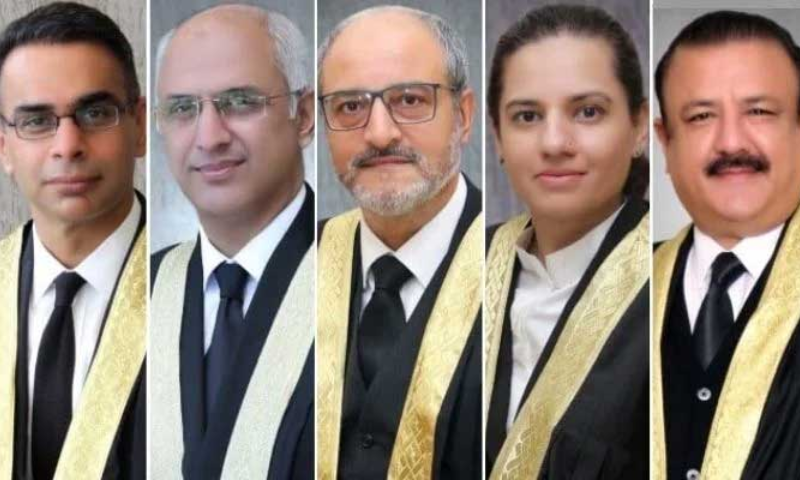
Islamabad, November 24, 2025: The Federal Constitutional Court (FCC) on Monday dismissed intra-court appeals (ICAs) filed by five Islamabad High Court (IHC) judges and several other petitioners challenging the Supreme Court’s June verdict on the transfer of three high court judges. The FCC upheld the earlier ruling, declaring that the appeals could not be returned to the Supreme Court.
The six-member larger bench, headed by Chief Justice Aminuddin Khan and comprising Justices Syed Hassan Azhar Rizvi, K. K. Agha, Aamer Farooq, Ali Baqir Najafi, Rozi Khan Barrech, and Arshad Hussain Shah, rejected the request to transfer the matter back to the Supreme Court due to non-compliance after none of the petitioners appeared before the court.
The appeals were filed by IHC Justices Mohsin Akhtar Kiyani, Tariq Mehmood Jahangiri, Babar Sattar, Sardar Ejaz Ishaq Khan, and Saman Riffat Imtiaz, who had argued that their ICAs could only be heard by the Supreme Court — not the newly formed FCC.
The dispute stems from the federal government’s decision to transfer three judges — Justice Sarfraz Dogar of the Lahore High Court, Justice Khadim Hussain Soomro of the Sindh High Court, and Justice Muhammad Asif of the Balochistan High Court — to the Islamabad High Court.
Multiple petitioners, including the Karachi Bar Association (KBA) and the IHC Bar Association, had challenged the transfers in the Supreme Court. The apex court dismissed the petitions in June, terming the government’s move constitutional.
Following that verdict, the five IHC judges filed an ICA before the Supreme Court, but the case was transferred to the FCC under the newly enacted 27th Constitutional Amendment, which created the Federal Constitutional Court and shifted certain constitutional appeals from the Supreme Court to the FCC.
The judges subsequently challenged the transfer, arguing that their appeal did not fall within the jurisdiction of Articles 175E or 175F, which outline the FCC’s mandate.
In their petition, the judges contended that the ICA was filed under Section 5 of the Supreme Court (Practice and Procedure) Act, 2023, and not under Articles 175E or 175F, the 27th Amendment did not amend the Act or address statutory appeals filed under it and under Article 175F(2), only appeals falling under the Article could be transferred to the FCC.
Therefore, transferring their ICA to the FCC was “without legal force”.
They argued that the amendment could not retroactively shift an appeal that did not fall under the FCC’s constitutional jurisdiction.
The petition also cited the newly inserted Article 175F(2), which states, “All petitions for leave to appeal, appeals or review applications… falling within the jurisdiction of the Federal Constitutional Court, filed or pending before the Supreme Court prior to commencement of the 27th Amendment, shall stand transferred to the FCC.”
The judges insisted that their appeal did not meet this threshold and should be returned to the Supreme Court — further arguing that the 27th Amendment itself lacked lawful authority.
Despite these arguments, the FCC rejected their plea due to the petitioners’ non-appearance and upheld the Supreme Court’s June ruling on the constitutionality of the transfers.
The bench also dismissed their request to move the case back to the apex court, effectively cementing the FCC’s jurisdiction over such appeals under the new constitutional framework.
In their ICA filed in June, the judges had urged that the Supreme Court’s verdict be “recalled and set aside in the interest of justice”, and had sought interim relief pending the appeal’s final adjudication.