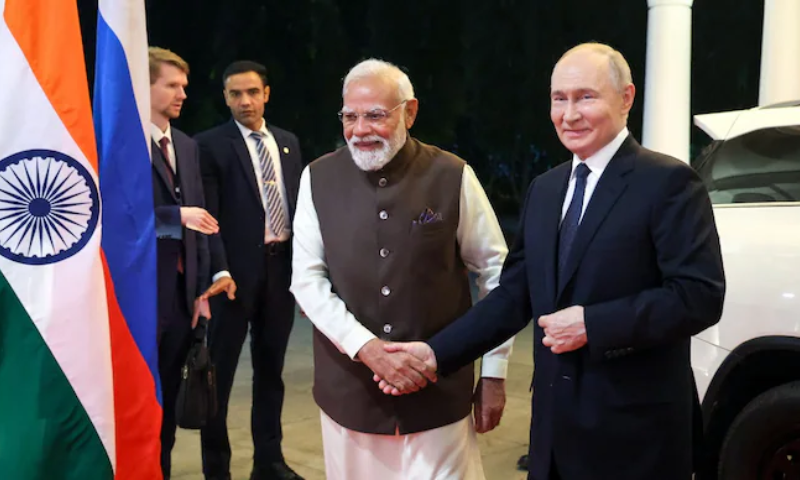
New Delhi, December 5, 2025: Russian President Vladimir Putin and Indian Prime Minister Narendra Modi opened crucial summit talks in New Delhi on Friday, with both leaders signalling a desire to strengthen strategic, economic and defence ties even as India navigates growing pressure from the United States over its partnership with Moscow.
Putin’s two-day visit — his first to India in four years — comes at a sensitive moment for New Delhi, which is simultaneously negotiating a trade deal with Washington to roll back punitive tariffs imposed by President Donald Trump over India’s continued purchases of discounted Russian oil.
Russia, long India’s top arms supplier, is seeking to expand imports of Indian goods to rebalance a trade relationship currently skewed by India’s large energy purchases. Moscow aims to raise bilateral trade to $100 billion by 2030.
India emerged as one of Russia’s most important energy customers after Europe cut off Russian oil following the invasion of Ukraine nearly four years ago. In 2024 alone, Russia supplied almost 36% of India’s crude oil, averaging 1.8 million barrels per day. But imports have since been reduced under escalating US sanctions and tariffs.
Facing American pressure on India to curb Russian oil purchases, Putin told Modi that Moscow remained ready to ensure continuous energy supplies.
“We are ready to continue uninterrupted shipments of fuel for the fast-growing Indian economy,” he said, calling Russia a reliable partner in energy, from oil and gas to coal.
Modi thanked Putin for his steadfast support but refrained from directly referencing crude imports, instead highlighting energy security and civil nuclear cooperation as pillars of the partnership.
Opening the summit, Modi stressed that India had a clear position on the Ukraine conflict.
“India is not neutral. India has a position, and that position is for peace,” he said. “We support every effort for peace, and we stand shoulder to shoulder with every initiative taken for peace.”
Putin thanked Modi for his “attention and efforts” toward resolving the crisis, saying the two leaders had discussed joint steps — including cooperation with the United States — toward a possible settlement.
Putin noted that as both economies grow, opportunities are widening in aviation, space, artificial intelligence, and high technologies. Defence Minister Andrei Belousov, part of Putin’s large delegation, told Indian officials that Russia was ready to support India’s drive for defence self-reliance.
Talks are also expected to cover labour mobility and expansion of civil nuclear projects.
Indian firms are likely to sign agreements with Russian fertiliser giant Uralchem to build a urea plant in Russia. Russian lenders Gazprombank and Alfa Bank are seeking approval to operate in India to facilitate bilateral trade.
In an interview aired on Thursday, Putin questioned why Washington was pressuring India over Russian oil while the US itself continued to buy Russian nuclear fuel.
“If the US has the right to buy our fuel, why shouldn’t India have the same privilege?” he said, signalling willingness to discuss the issue directly with President Trump.
India says US tariffs — including a 50% duty on most Indian goods — are discriminatory and highlight Western double standards, noting that both the US and EU continue importing billions of dollars’ worth of Russian commodities, including LNG and enriched uranium.
Putin’s visit comes a day after his discussions with Trump’s envoys on a possible peace proposal for Ukraine, talks that ended without a breakthrough.
New Delhi has avoided condemning Russia over the war, arguing that dialogue and diplomacy are the only path to peace and that India’s longstanding partnership with Moscow is being unfairly targeted.
“India faces a conundrum; by taking steps to strengthen ties with Moscow or Washington, New Delhi risks setting back ties with the other,” wrote Michael Kugelman of the Atlantic Council in Foreign Policy this week.
Putin received a ceremonial reception at Rashtrapati Bhavan, complete with a 21-gun salute. Modi personally greeted him at the airport on Thursday and hosted a private dinner.
A series of agreements is expected following the formal talks, underscoring efforts by both sides to stabilise and deepen a partnership under strain from global geopolitical shifts.