Sydney/Islamabad, December 17, 2025: An Indian passport belonging to Sajid Akram, one of the attackers involved in the deadly shooting at Sydney’s Bondi Beach during a Jewish Hanukkah celebration, has surfaced, according to Filipino media reports. The December 14 attack left at least 15 people dead and two police officers critically injured, New South Wales police said.
Australian authorities identified the assailants as a father-and-son duo, Sajid Akram, 50, and his son Naveed. The two opened fire during the religious event, an incident that shocked the nation and heightened concerns over rising antisemitism and violent extremism.
Victims of the attack included a rabbi who was a father of five, a Holocaust survivor, and a 10-year-old girl, Matilda Britvan, according to officials and media reports. The injured police officers remain in critical but stable condition.
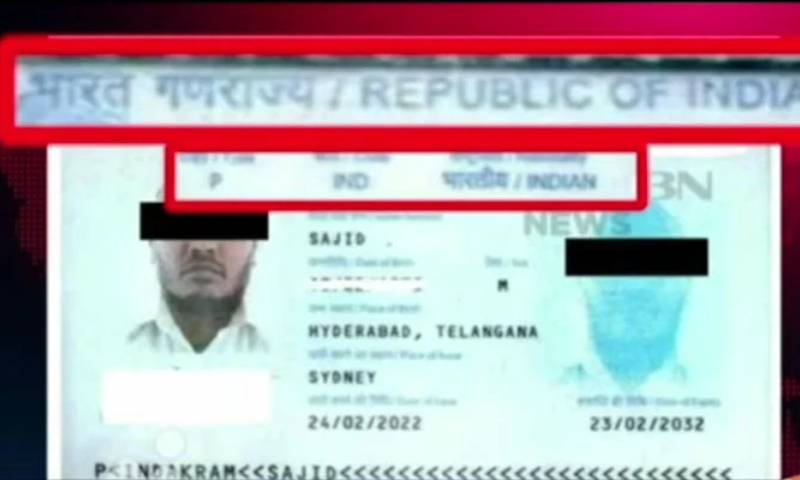
Records obtained by the Philippines’ ABS-CBN News showed that Naveed held an Australian passport, while Sajid entered Australia on an Indian passport. The document, issued by the Indian High Commission on February 24, 2022, is valid until February 23, 2032, and lists Hyderabad in India’s Telangana state as Sajid Akram’s place of origin.
According to the reports, authorities were aware of Sajid’s Indian citizenship from the outset. However, the incident was initially portrayed otherwise in some quarters, with attempts made to link the attack to Pakistan. Subsequent information also indicated that Naveed Akram held an Indian passport, a detail that, according to sources, was not immediately disclosed.
Several Indian media outlets were later accused of running misleading reports that identified the attackers as Pakistani nationals. The narrative collapsed the following day after evidence of the attackers’ Indian nationality emerged publicly.
Last year, British newspaper The Guardian reported that Australia expelled two Research and Analysis Wing (RAW) operatives in 2020 over alleged illegal activities, including profiling members of the Indian diaspora.
Philippines rejects training allegations
Meanwhile, the Philippines’ National Security Adviser Eduardo Año said on Wednesday there was no evidence to suggest that the suspects received any form of military or terrorist training while in the country.
In a statement, Año said a brief visit could not substantiate allegations of organised training, adding that the duration of the suspects’ stay would not have permitted any meaningful instruction. He said authorities were investigating the pair’s travel between November 1 and 28 and coordinating closely with Australian officials to determine the purpose of the visit.
Año dismissed media portrayals of southern Philippines as a hub for violent extremism as “outdated” and “misleading”.
Immigration records showed that Sajid and Naveed arrived in Manila from Sydney on November 1 and travelled to Davao City in Mindanao before returning to Australia on November 28 via Manila. Australian police have said the attack appeared to have been inspired by Daesh.
Separately, the Davao Regional Police said a multi-agency probe was underway to verify reports of the duo’s presence in the region. Police Regional Office 11 spokesperson Maj Catherine Dela Rey said investigators were examining where the men stayed and whom they met, if they arrived in Davao at all. She assured the public that the region remained peaceful despite being linked to an overseas terror incident.
Pakistan condemns ‘false media campaign’
In Islamabad, Federal Minister for Information Attaullah Tarar strongly condemned what he described as a “false and deliberate misinformation campaign” aimed at maligning Pakistan in the aftermath of the Bondi Beach shooting.
Briefing foreign media on Wednesday, Tarar called the December 14 attack “a very sad and highly condemnable incident” and said Prime Minister Shehbaz Sharif, President Asif Ali Zardari and the government of Pakistan had expressed solidarity with Australia and its people.
Tarar said Pakistan, having suffered from terrorism for years, fully understood the pain of such tragedies. He also paid tribute to a Syrian-origin Australian citizen who subdued one of the attackers, saving several lives.
The minister said certain international media outlets were quick to falsely claim that one of the attackers was from Lahore, despite there being no evidence or verification. He said the unverified reports spread rapidly across social and electronic media in Israel and India.
Referring to the anniversary of the December 16, 2014, Army Public School attack in Peshawar, Tarar said it was deeply unfortunate that Pakistan was targeted by a disinformation campaign on a day the nation was remembering one of the most tragic incidents in its history.
“There was not even a shred of evidence to support the claim that any of the attackers was from Pakistan,” he said, expressing regret that some reputed international media organisations published the claims without due verification.
Tarar said the false narrative was eventually refuted after Indian police confirmed that one of the attackers was from Hyderabad and that the passport had been issued by Indian authorities. He added that Philippine officials had also confirmed the attacker’s travel history on the same passport.
Praising Australian authorities for conducting a professional investigation and refraining from speculation, Tarar questioned who would compensate Pakistan for the reputational damage caused by the false reports.
Referring to other cases of alleged transnational terrorism, including the killing of Canadian Sikh activist Hardeep Singh Nijjar, Tarar said Pakistan had presented what he termed “irrefutable evidence” of Indian involvement in militant activities in Balochistan and Khyber Pakhtunkhwa.
“Pakistan has always condemned terrorism in all its forms and manifestations and has acted responsibly by verifying facts before reacting,” the minister said.