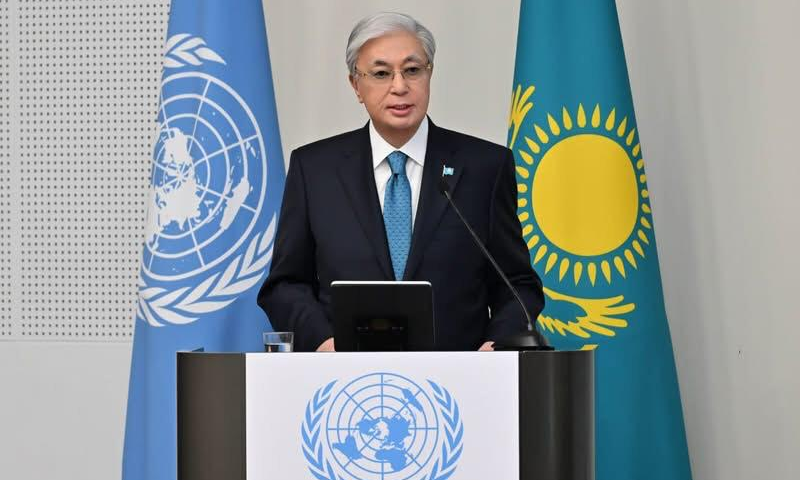
Tokyo, December 19, 2025: President of the Republic of Kazakhstan Kassym-Jomart Tokayev on Friday delivered a keynote lecture at the United Nations University (UNU) in Tokyo, calling for the restoration of strategic trust, comprehensive UN reform and greater inclusion of responsible middle powers in global decision-making amid growing international instability.
In his lecture, titled “Restoring Strategic Trust in an Era of Turbulence: How Kazakhstan Envisions a More Just and Stable World,” President Tokayev said it was a great honour to address the prestigious institution as the first head of state from Central Asia to do so. He described the invitation as recognition of Kazakhstan’s growing international role and its efforts to promote multilateralism and global stability.
Recalling his own service at the United Nations as Under-Secretary-General and Director-General of the UN Office at Geneva, as well as Secretary-General of the Conference on Disarmament, President Tokayev congratulated UNU on the 50th anniversary of its establishment and praised its contribution to developing practical solutions for global challenges.
Highlighting the importance of harmony in governance and international relations, President Tokayev said the principles of Japanese ethics resonated strongly with Kazakhstan’s foreign policy outlook. Quoting 7th-century Japanese statesman Prince Shotoku, he noted that “harmony should be valued above all,” adding that this concept remained central to Kazakhstan’s approach to diplomacy.
Expressing concern over the rising number of global conflicts, President Tokayev warned that the world was witnessing the highest intensity of armed conflicts in decades, alongside record global military spending of $2.7 trillion last year. He said escalating rivalry among major powers had weakened multilateral mechanisms, particularly the UN Security Council’s ability to resolve major international crises.
“A renewed culture of strategic trust must become the foundation of international cooperation and collective decision-making,” he said, stressing that no country could tackle today’s challenges alone. He reaffirmed Kazakhstan’s commitment to promoting trust through initiatives such as the Conference on Interaction and Confidence-Building Measures in Asia and the Congress of Leaders of World and Traditional Religions, while underscoring the UN’s irreplaceable role in global affairs.
President Tokayev also called for comprehensive reform of the United Nations, saying it was no longer a rhetorical issue but a strategic necessity. While reaffirming the importance of the UN Charter’s core principles—sovereignty, territorial integrity and peaceful dispute resolution—he said certain provisions no longer reflected 21st-century realities and were unfair to countries like Japan that make significant contributions to the organisation.
He described reform of the UN Security Council as urgent, urging broader participation by responsible middle powers from Asia, Africa and Latin America. Such states, he said, could act as constructive mediators and help bridge divides among major powers. President Tokayev added that Kazakhstan viewed this role as central to its balanced, multi-vector foreign policy.
During the visit, President Tokayev also expressed appreciation to former Japanese foreign minister Yoriko Kawaguchi for her role in strengthening bilateral ties, recalling her initiative to launch the “Central Asia + Japan” dialogue format.
Outlining Kazakhstan’s foreign policy priorities, he said the country was developing comprehensive strategic partnerships with neighbouring Russia, China and Central Asian states, while also expanding engagement with the United States, the European Union, the Middle East, Asia and the Global South. He described Japan as a key partner and said Kazakhstan would continue to deepen cooperation in trade and investment.
President Tokayev also devoted part of his address to the growing nuclear threat, noting that Kazakhstan and Japan shared a deep understanding of the devastating consequences of nuclear weapons. He stressed that global security could not be built on nuclear deterrence and called for renewed international commitment to disarmament and non-proliferation.