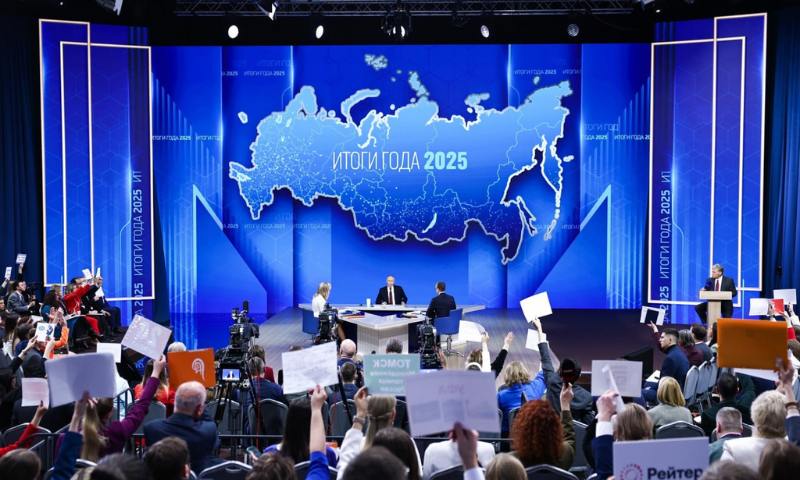
Moscow, December 19, 2025: Russian President Vladimir Putin on Thursday defended his country’s economic and foreign policy choices while reiterating Moscow’s readiness for negotiations to end the conflict in Ukraine, during his annual year-end conference with journalists and members of the public.
Addressing questions on the economy, Putin said Russia’s gross domestic product (GDP) grew by 1 per cent in 2025, but stressed that cumulative growth over the past three years stood at 9.7 per cent. By comparison, he noted, the eurozone recorded growth of 3.1 per cent over the same period. The slower pace of expansion, he argued, was a deliberate policy choice aimed at preserving economic quality, stability and strong macroeconomic fundamentals.
Putin also warned against what he described as attempts in Brussels to seize Russian assets, calling such moves “robbery” rather than theft because they are being carried out openly. He said the reason these actions had not yet been fully implemented was the potentially severe consequences for those involved, including damage to their reputation and to the foundations of the global financial system. Any assets taken, he added, would ultimately have to be returned, and Russia would defend its interests primarily through legal means.
On the war in Ukraine, Putin rejected claims that Moscow was blocking peace initiatives, calling them “completely baseless.” He said Russia had repeatedly declared its readiness to make compromises and that the initiative now lay with the West, particularly the authorities in Kyiv and their European backers. Russia, he said, remained open to negotiations and a peaceful settlement.
The Russian president underscored the continued relevance of building a new European security architecture, recalling earlier proposals for a system that would include the United States, Eastern Europe and Russia, without NATO expansion and without threats to any side. While reaffirming that countries have the right to choose their means of defence, Putin said such choices must not endanger others, including Russia.
Putin accused Europe’s ruling elites of using the narrative of a “hostile Russia” to mask years of economic and social policy failures. He questioned the credibility of Europe’s green agenda, pointing to the reopening of coal-fired power plants and the return of nuclear power, and said the current situation was the result of decisions taken by Western politicians who continue to escalate tensions.
Commenting on US politics, Putin said previous accusations that former US president Donald Trump colluded with Russia during elections had proven unfounded, adding that no Russian interference had taken place. In contrast, he claimed European political elites had intervened openly, and suggested some in Europe were hoping the 2026 US midterm elections would shift the political balance and allow for increased pressure on Trump.
Putin also argued that in purchasing power parity terms, the combined GDP of Russia and European countries would exceed that of the United States, saying cooperation rather than confrontation could allow all sides to prosper. He insisted that Russia was not fighting Europe, but that Europe was confronting Russia “through Ukrainian nationalists.” Moscow, he said, was ready to halt hostilities immediately, provided Russia’s security was guaranteed in the medium and long term.
Warning against threats to Russia’s territorial integrity, Putin said he hoped a blockade of the Kaliningrad region would never occur, but cautioned that any such threats would be eliminated. He said such actions would trigger unprecedented escalation, potentially pushing the conflict to a much broader and more dangerous level.
The Russian leader also expressed concern over what he described as increasingly aggressive rhetoric from NATO leaders. He noted that Russia is not formally designated as an enemy in the updated US National Security Strategy, despite the United States being NATO’s leading member. By contrast, he said statements by NATO Secretary General Mark Rutte about preparing for war with Russia contradicted Washington’s position and reflected a lack of professional responsibility among some Western leaders.
Concluding his remarks, Putin said Russia remained ready to work with the United Kingdom, Europe as a whole and the United States, but only on the basis of equality and mutual respect. “If such a point is reached,” he said, “it will benefit everyone.”