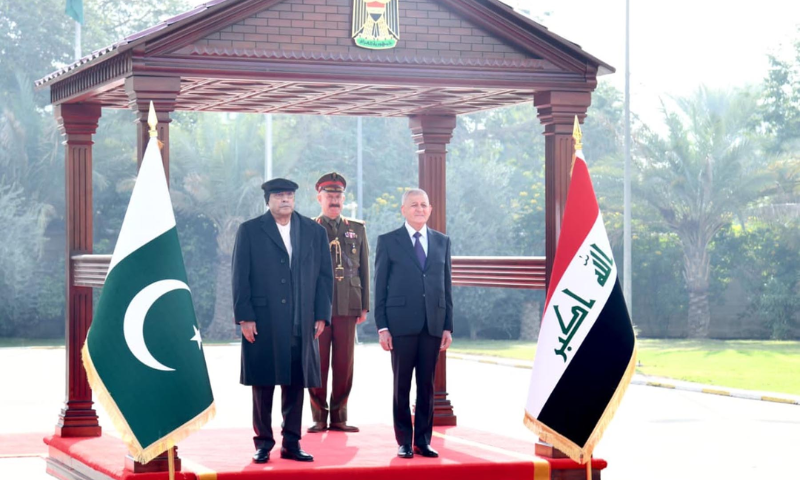
Islamabad/Baghdad, December 21, 2025: President Asif Ali Zardari on Sunday commenced a four-day official visit to Iraq, aimed at strengthening bilateral relations and expanding cooperation across a range of key sectors.
According to the President’s House, President Zardari was received at Baghdad International Airport by Iraq’s Minister of Culture, Tourism and Antiquities, Ahmed Fakak Al-Badrani, who led the official reception alongside senior officials from the Iraqi presidency. An official welcoming ceremony is scheduled to be held at Baghdad Palace later on December 21, followed by talks between Iraqi President Abdul Latif Jamal Rashid and President Zardari. Expanded delegation-level discussions between the two sides are also planned.
Iraq and Pakistan share longstanding diplomatic relations and have recently sought to broaden cooperation in multiple fields, as Baghdad continues efforts to deepen engagement with Asian partners and diversify its international partnerships. While en route from Islamabad to Baghdad, President Zardari conveyed a goodwill message to the Iranian leadership as his aircraft entered Iranian airspace, reaffirming solidarity with Iran and underscoring mutual respect and the importance of stronger regional relations.
In a curtain-raiser issued a day earlier, the Foreign Office said the president is visiting Iraq at the invitation of President Rashid and will remain there from December 20 to 24, 2025. The FO noted that the visit underscores the traditionally warm and brotherly relations between Pakistan and Iraq, rooted in shared bonds of faith, culture and mutual respect. During the visit, President Zardari will hold high-level meetings to review the full spectrum of bilateral relations and explore avenues to enhance cooperation in areas including trade and investment, energy, reconstruction, manpower, technology, education and people-to-people exchanges. Discussions will also cover regional and international developments, as well as collaboration at multilateral fora. The visit is expected to further reinforce ties, identify new partnership opportunities and strengthen people-to-people linkages, particularly in religious tourism and economic cooperation.