Bangkok/Phnom Penh, December 27, 2025: Thailand and Cambodia on Saturday agreed to halt weeks of fierce border clashes—the worst fighting between the Southeast Asian neighbours in years, which included fighter jet sorties, artillery barrages, and rocket fire.
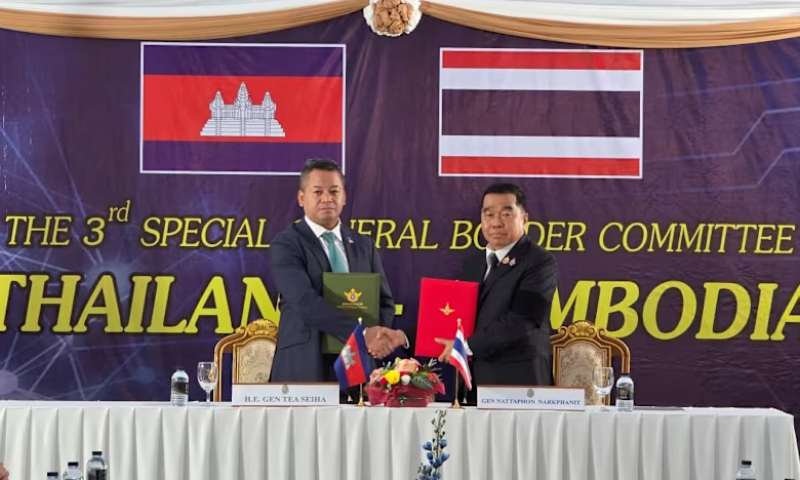
The agreement, announced in a joint statement by Thai Defence Minister Natthaphon Nakrphanit and Cambodian counterpart Tea Seiha, calls for both sides to “maintain current troop deployments without further movement,” warning that any reinforcement could escalate tensions and undermine long-term peace efforts.
The recent fighting, which erupted in early December after a breakdown of a previous July ceasefire, has claimed at least 101 lives and displaced more than 500,000 people on both sides of the border.
The July truce, brokered with the assistance of US President Donald Trump and Malaysian Prime Minister Anwar Ibrahim, had ended a five-day clash that killed 48 people and displaced 300,000. However, renewed tensions in December reignited the conflict, spreading from forested regions near Laos to coastal provinces along the Gulf of Thailand.
Under Saturday’s ceasefire, ASEAN will deploy an observer team to monitor compliance, while both countries will maintain direct communication between their defence ministries and armed forces. The pact also includes provisions for the return of displaced civilians and ensures that neither side will use force against them. Thailand has additionally agreed to return 18 Cambodian soldiers held since the July clashes if the ceasefire holds for 72 hours.
Officials emphasized that the ceasefire does not affect ongoing border demarcation activities, which will continue under existing bilateral mechanisms. “War and clashes don’t make the two countries or the two people happy,” said Thailand’s Air Chief Marshal Prapas Sornjaidee. “I want to stress that the Thai people and the Cambodian people are not in conflict with each other.”
The ceasefire comes after a special meeting of Southeast Asian foreign ministers in Kuala Lumpur earlier this week, followed by three days of direct talks at a border checkpoint between the warring parties. Both sides hailed the agreement as a crucial step toward restoring stability along the contested 817-kilometre frontier.