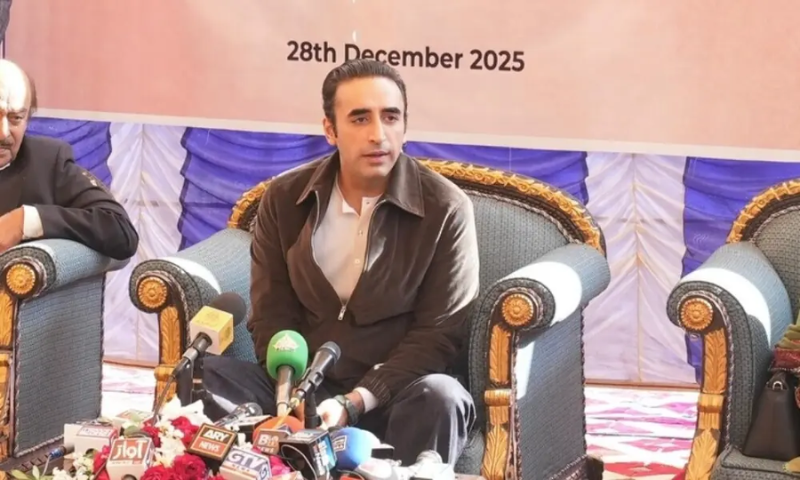
Larkana, December 28, 2025: Pakistan People’s Party (PPP) Chairman Bilawal Bhutto-Zardari on Sunday urged the Pakistan Tehreek-e-Insaf (PTI) to abandon what he termed “political extremism” and return to democratic politics, warning that attacks on state institutions over the arrest of party leaders invite serious consequences.
Speaking to the media in Larkana, Bilawal said PTI targeted state institutions following what he described as a “meagre NAB case” against its founder, Imran Khan. “You attacked our state institutions just because of a meagre NAB case against your leader, then don’t complain,” he remarked.
The PPP chief called on PTI to shun hardline politics and rejoin the democratic process. “Do away with political extremism and return to the democratic fold. This will be better not only for their party but also for their workers,” he said.
Bilawal, who has previously served as foreign minister and whose party is an ally of the ruling Pakistan Muslim League-Nawaz (PML-N), reiterated that he remains opposed to any proposal to ban PTI, despite recent speculation in this regard. However, he stressed that political parties must seek political solutions for the survival of democracy, warning that those who adopt extremist politics should not complain about a strict response.
Commenting on the political roadmap, Bilawal said it was “written on the wall” that elections would not be held anytime soon, emphasizing the need for comprehensive electoral reforms before fresh polls. “We should try to bring such electoral reforms that everyone can trust,” he added.
He also said that, given the prevailing political situation, President Asif Ali Zardari would need to play a role in bringing all political parties to consensus. Bilawal dismissed reports of a proposed 28th constitutional amendment, saying such discussions were confined to media speculation.
Referring to his address at a gathering a day earlier, Bilawal reiterated the need for reconciliation to steer the country out of political and economic crises. He said President Zardari was uniquely positioned to reduce political polarization, which he described as damaging to democracy, the economy, and national security. “If Pakistan is pulled out of the political crisis, it will automatically help the country emerge from the economic crisis as well,” he said.
On the economy, Bilawal said the country’s real financial condition could best be gauged by the situation of ordinary citizens. He added that if the federal government wanted to effectively tackle the economic crisis, it should explore public-private partnerships as part of its strategy.