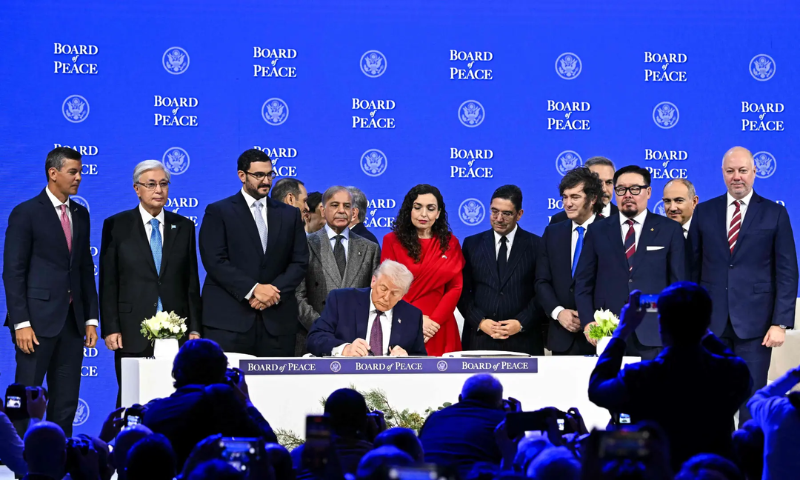
Davos, January 22, 2026: Prime Minister Shehbaz Sharif on Thursday joined a group of world leaders in signing the founding charter of the newly formed Board of Peace, a US-backed international body spearheaded by President Donald Trump and initially conceived to oversee post-war arrangements in Gaza.
The signing ceremony took place on the sidelines of the World Economic Forum in Davos, Switzerland, where leaders and senior officials from 19 countries, including Pakistan, gathered on stage with Trump to formalise the charter. The US president will serve as chairman of the Board, which he has billed as a platform for resolving international conflicts.
Although originally proposed to supervise peace and reconstruction efforts in Gaza following Israel’s two-year war on the Palestinian enclave, the charter outlines a broader mandate, positioning the Board of Peace as a global conflict-resolution forum.
“Congratulations, President Trump. The charter is now in full force, and the Board of Peace is now an official international organisation,” White House Press Secretary Karoline Leavitt announced at the ceremony.
Trump, addressing the signatories, described them as “in most cases very popular leaders, in some cases not so popular,” adding, “That’s the way it goes in life.” He also said that interest in joining the body was widespread. “Just about every country wants to be a part of it. We sent out the letters a couple of days ago and countries that are here just happened to be in Davos,” he remarked.
Pakistan had formally accepted Trump’s invitation to join the Board a day earlier. Prime Minister Shehbaz was among the leaders seated in the audience and later took part in signing the charter.
Membership questions and UN concerns
Under the Board’s structure, permanent members are required to contribute $1 billion, a provision that has drawn criticism from observers who fear the body could evolve into a “pay-to-play” version of the United Nations Security Council.
Trump sought to allay concerns that the Board of Peace might rival the UN, saying it would operate “in conjunction” with the world body. “Once this board is completely formed, we can do pretty much whatever we want to do, and we’ll do it in conjunction with the United Nations,” he said, calling the potential partnership “very, very unique for the world.”
So far, none of the other permanent members of the UN Security Council — apart from the United States — have committed to joining. France has declined to participate, Britain said it was not joining “at present,” while China has yet to announce a position.
Officials from Argentina, Armenia, Azerbaijan, Bahrain, Bulgaria, Hungary, Indonesia, Jordan, Kazakhstan, Kosovo, Mongolia, Morocco, Paraguay, Qatar, Saudi Arabia, Türkiye, the United Arab Emirates and Uzbekistan also signed the charter.
The Board’s proposed membership has generated controversy, particularly after Trump extended invitations to Israeli Prime Minister Benjamin Netanyahu — who faces an International Criminal Court arrest warrant over alleged war crimes in Gaza — and Russian President Vladimir Putin. Netanyahu has said Israel will join but did not attend the ceremony, while Putin said he was still reviewing the invitation despite Trump’s claim that the Russian leader had agreed.
Reuters reporters at the event noted the absence of representatives from major global powers, as well as from Israel and the Palestinian Authority.
Trump warns Hamas, pushes ‘New Gaza’ vision
In a wide-ranging speech, Trump warned that Hamas must disarm under the Gaza ceasefire deal or face destruction. “They have to give up their weapons, and if they don’t do that, it’s going to be the end of them,” he said.
He reiterated Washington’s commitment to a demilitarised and rebuilt Gaza, describing the devastated territory as “great real estate” and unveiling ambitious plans for what officials dubbed a “New Gaza.”
Trump’s son-in-law, Jared Kushner, presented slides outlining a proposed master plan for Gaza’s reconstruction, featuring artist impressions of seafront hotels, apartments and new settlements. “It could be a hope. It could be a destination,” Kushner said, adding that disarmament by Hamas remained the central obstacle. “If Hamas doesn’t demilitarise, that would be what holds this plan back.”
Kushner said the next phase of the ceasefire would focus on reconstruction funding, humanitarian relief and governance, with intensive work planned over the next 100 days.
Trump also claimed that Iran was seeking talks with the United States and that Washington was open to engagement, while recalling US strikes on Iranian uranium enrichment sites in June 2025. “Can’t let that happen,” he said, referring to Tehran’s alleged nuclear ambitions.
US officials stress Gaza-first approach
US Secretary of State Marco Rubio described the initiative as a “Board of Peace” and a “board of action,” stressing that Gaza remained the immediate priority. “The focus is right now on Gaza and making sure that this peace deal becomes enduring,” he said, adding that the effort could serve as a model for resolving other seemingly intractable conflicts.
Middle East envoy Steve Witkoff also addressed the gathering, echoing the administration’s commitment to sustaining the ceasefire and advancing reconstruction.
Rafah crossing to reopen
In a significant announcement, Ali Shaath, the newly appointed administrator of Gaza under the US-backed plan, said the Rafah border crossing with Egypt would reopen in both directions next week.
“For Palestinians in Gaza, Rafah is more than a gate; it is a lifeline and symbol of opportunity,” Shaath said. “Opening Rafah signals that Gaza is no longer closed to the future and the world.”
Shaath, a former Palestinian Authority deputy minister, has been tasked with leading a 15-member committee of Palestinian technocrats to oversee Gaza’s day-to-day administration as part of the truce framework.
As the Board of Peace begins its work, its ambitious scope, funding model and political inclusions are likely to remain under intense international scrutiny, even as Washington pushes it as a cornerstone of a new global peace architecture.