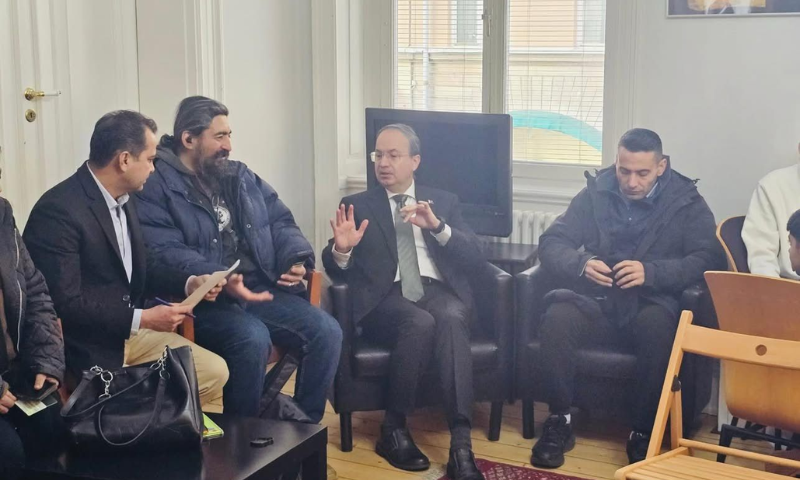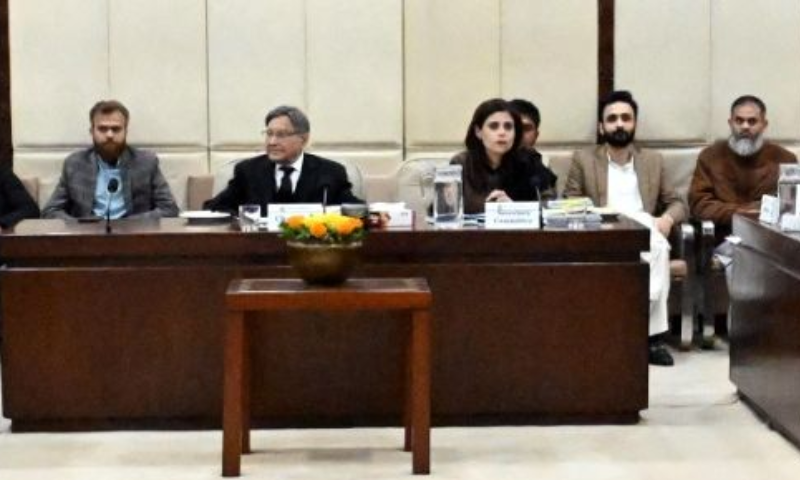
Islamabad, February 3, 2026: A meeting of the Senate Standing Committee on Law and Justice was held at Parliament House under the chairmanship of Senator Farooq Hamid Naek to deliberate on several constitutional amendment bills and legislative proposals.
Senators Mohammad Abdul Qadir, Shahadat Awan, Kamran Murtaza, and Samina Mumtaz Zehri attended the meeting, while Senator Sarmad Ali participated virtually. The Minister of State for Law and Justice was also present.
The committee took up further consideration of The Constitution (Amendment) Bill, 2024 seeking an amendment to Article 62, introduced by Senator Samina Mumtaz Zehri on September 9, 2024. The proposed amendment aimed to make graduation a mandatory qualification for appointment to key constitutional and public offices, including the President, Prime Minister, Governors, Chief Ministers, parliamentary leadership, and federal and provincial ministers. The mover argued that holders of such high offices bear enhanced constitutional responsibilities and public trust, necessitating elevated eligibility standards.
During deliberations, responses from all provincial governments opposed the amendment, citing constitutional concerns, including a potential conflict with Article 25 (Equality of Citizens). Chairperson Naek observed that the proposed requirement could undermine the constitutional principle of equality, while Senator Abdul Qadir remarked that states are governed by wisdom, experience, and vision rather than academic degrees alone, distinguishing between education and qualification.
The Minister of State appreciated the intent behind the amendment and acknowledged the mover’s objective to strengthen governance standards. However, in light of provincial feedback and the sense of the committee, the member-in-charge withdrew the bill.
The committee also considered The Constitution (Amendment) Bills, 2025, proposing amendments to Articles 228 and 153, introduced by Senator Zeeshan Khanzada Khan, both aimed at enhancing women’s representation in constitutional bodies.
Regarding Article 228, the committee reviewed the Council of Islamic Ideology’s (CII) response, which stated that the Constitution does not bar the appointment of women as members and that at least one female member is already ensured. Women possessing the requisite qualifications may be appointed without any constitutional amendment; therefore, the committee concluded that no amendment was required.
Similarly, the ministry concerned opposed the proposed amendment to Article 153 related to the Council of Common Interests (CCI), noting that the Constitution already permits the Prime Minister to appoint qualified women as members. The committee was informed that no constitutional restriction exists, rendering the amendment unnecessary. Accordingly, both bills were disposed of with the recommendation that they not be passed by the House.
The committee further considered The Family Courts (Amendment) Bill, 2026, introduced by Senator Sarmad Ali during the Senate sitting held on January 19, 2026. During clause-by-clause review, the proposed amendment to Section 9 was withdrawn. However, the amendment to Section 11 was approved with an additional provision allowing family courts to permit audio and video recording of statements, subject to judicial discretion and the consent of the parties concerned.