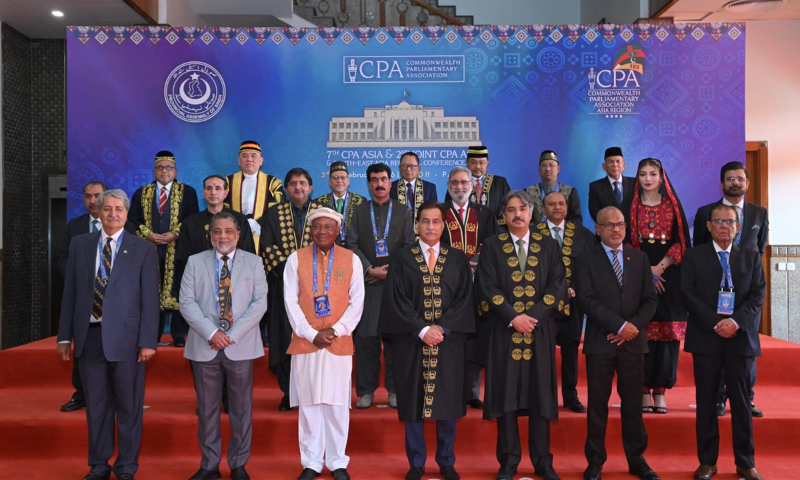
Islamabad, February 4, 2026: Speaker of the National Assembly, Sardar Ayaz Sadiq, on Wednesday addressed distinguished parliamentarians and dignitaries from 13 Commonwealth Parliamentary Association (CPA) countries as Chief Guest at the inaugural ceremony of the 7th CPA Asia Regional Conference and the 2nd Joint CPA Asia & South-East Asia Regional Parliamentary Conference, hosted by the Provincial Assembly of Sindh.
The conference is attended by Speakers, parliamentarians, ministers, members of parliament, representatives of provincial and legislative assemblies of Pakistan, and senior officials of the CPA. Speaker Sadiq extended a warm welcome to all international delegates, calling their presence a reflection of shared democratic values.
Highlighting inter-parliamentary cooperation, he noted that he, the Chairman of the Senate, and the Speakers of Pakistan’s four provincial assemblies, along with the assemblies of Azad Jammu & Kashmir and Gilgit-Baltistan, meet regularly to strengthen democracy, promote inter-provincial harmony, and enhance parliamentary coordination. He pointed out that despite differences in parliamentary rules in the past, joint consultations led to the adoption of identical rules across all legislative forums—a landmark achievement for parliamentary harmony.
Speaker Sadiq lauded the Sindh Assembly for hosting what he described as a historic and landmark conference, recalling that Sindh elected Asia’s first woman Deputy Speaker, Ms. Jethi Bai Tulsidas, in 1946, and later gave Pakistan and Asia its first woman Prime Minister, Shaheed Mohtarma Benazir Bhutto.
Speaking on the conference theme, “Trust, Inclusion, Innovation, and Peace,” the NA Speaker emphasized that these principles are foundational pillars for future democratic systems and closely reflect Pakistan’s national aspirations. He drew attention to Pakistan’s demographic reality, noting that over 65 percent of the population is youth, yet only 2–3 percent are represented in legislatures—a profound democratic deficit. He called on parliamentarians to bridge this gap through Youth Advisory Councils, structured internships, leadership nurturing, and youth representation in parliamentary committees.
On inclusiveness, Speaker Sadiq stressed that representation of women, minorities, marginalized communities, and persons with disabilities is not a privilege but a democratic duty, noting that diverse parliaments produce stronger legislation and governance rooted in justice and equality.
Speaking on innovation, he underscored the importance of technology in modern governance, highlighting AI-enabled legislative research, digital documentation, and e-parliament systems to enhance transparency, efficiency, and public engagement. Open-data governance and digital citizen platforms, he said, bring parliaments closer to the people and strengthen democratic accountability.
He further emphasized accountability as the cornerstone of democratic legitimacy, stressing the need for oversight committees with research capacity, accurate data, and institutional independence. He highlighted the importance of federalism and balanced power-sharing between the federation and provinces to ensure unity, equitable development, and national stability.
On regional and global peace, Speaker Sadiq underscored the crucial role of parliaments in advocating humanitarian principles, protecting political rights, and promoting peaceful conflict resolution. He reaffirmed Pakistan’s unwavering support for the people of Indian Illegally Occupied Jammu & Kashmir (IIOJK) and their right to self-determination as enshrined in UN Security Council resolutions. He also called for urgent global action to address the humanitarian crisis in Gaza based on justice, dignity, and human rights.
Concluding his address, Speaker Sadiq highlighted that ethical leadership, integrity, transparency, and modernization are hallmarks of enduring democratic institutions. Transparent law-making and active citizen engagement, he said, strengthen public trust and reinforce democratic legitimacy.
In a lighter moment, he observed that the role of a Speaker in Pakistan is uniquely challenging, noting that government benches often criticize giving too much time to the opposition, while the opposition simultaneously complains about insufficient floor time.
This conference, he emphasized, offers a platform for parliaments to become more representative, innovative, and accountable, ensuring that public trust remains democracy’s greatest asset.