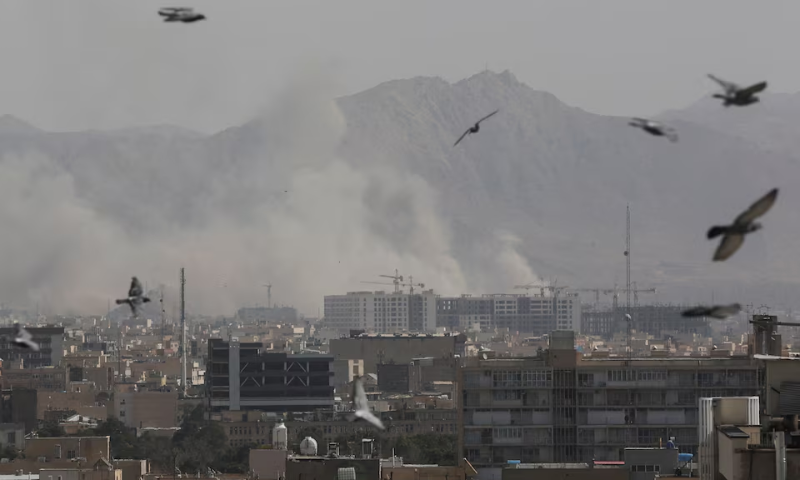
Washington/Tel Aviv/Tehran, February 28, 2026: The United States and Israel launched coordinated strikes on Iran on Saturday, targeting senior leadership and key infrastructure in what marks a dramatic escalation and a new phase of conflict in the Middle East.
President Donald Trump said the operation was aimed at eliminating a security threat to the United States and preventing Iran from acquiring a nuclear weapon. The Pentagon named the campaign “OPERATION EPIC FURY,” with officials indicating it could last several days.
Tehran swiftly retaliated by launching missiles toward Israel, while explosions were reported across parts of the Gulf region. Oil-producing Gulf Arab states said they had intercepted Iranian missiles after Tehran warned it would target regional bases hosting U.S. forces if attacked.
Leadership targeted, casualties reported
A source familiar with the matter said the first wave of strikes primarily targeted Iranian officials. An Israeli official stated that Supreme Leader Ali Khamenei and President Masoud Pezeshkian were among those targeted, though the outcome remained unclear. Earlier reports suggested Khamenei had been moved to a secure location outside Tehran.
An Iranian source close to the establishment said several senior commanders of the Islamic Revolutionary Guard Corps had been killed. Iranian state media reported that 40 people died in an Israeli airstrike on a girls’ primary school in southern Iran, though the reports could not be independently verified.
Gulf states on high alert
Loud blasts were heard in Abu Dhabi, capital of the United Arab Emirates, with fighter jets seen over Yas Island. Explosions were also reported in Dubai.
Bahrain said a service center of the U.S. Fifth Fleet had been struck by a missile. Witness footage showed smoke rising near the coastline as sirens wailed. Qatar said it intercepted all missiles targeting its territory and reserved the right to respond. Sirens were heard in Doha.
Explosions were also reported near Iran’s Kharg Island, through which roughly 90 percent of Iran’s crude oil exports pass via the Strait of Hormuz, raising fears of disruption to global energy supplies.
Diplomatic hopes fade
The renewed confrontation has dimmed hopes of resolving Tehran’s nuclear dispute with the West through diplomacy. Indirect talks between Washington and Tehran earlier this week failed to yield progress.
In a video message, President Trump cited decades of tensions with Iran, including the 1979 U.S. embassy hostage crisis, and urged Iranian citizens to seek shelter, warning that “bombs will be dropping everywhere.” He also called on Iranians to “take over your government” once the operation concludes.
Israeli Prime Minister Benjamin Netanyahu described the joint strikes as creating conditions for Iranians to “take their destiny into their own hands,” while Defence Minister Israel Katz termed the action a pre-emptive strike against imminent threats.
Iran’s Revolutionary Guards declared that all U.S. bases and interests in the region were within reach and said retaliation would continue until “the enemy is decisively defeated.” Iran’s foreign minister told counterparts in Saudi Arabia, the UAE, Qatar, Kuwait, Bahrain, and Iraq that Tehran would use all defensive capabilities at its disposal.
Regional fallout and market impact
The escalating conflict prompted global airlines to cancel flights across the Middle East. Oil markets reacted nervously, with analysts warning that crude prices could surge sharply if tensions persist.
“If we don’t see signs of de-escalation over the weekend, risk premiums could drive Brent up by $10–$20 per barrel on Monday,” said Jorge Leon, head of geopolitical analysis at Rystad Energy.
Inside Tehran, residents rushed to withdraw cash and queue at gas stations amid fears of further escalation and potential internet shutdowns. Some families began leaving major cities.
The operation follows a 12-day air war last June between Israel and Iran and repeated U.S.-Israeli warnings that they would act if Tehran advanced its nuclear and ballistic missile programmes. U.S. officials said the current campaign was designed to neutralize imminent threats and ensure Iran does not obtain nuclear weapons.
As the conflict widens and retaliation continues, the Middle East stands on the brink of a broader regional war, with global economic and security implications hanging in the balance.