New York, March 1, 2026: Pakistan has warned the United Nations Security Council (UNSC) that the United States–Israeli attack on Iran, followed by retaliatory strikes, could undermine the security of the entire Middle East with “far-reaching consequences.”
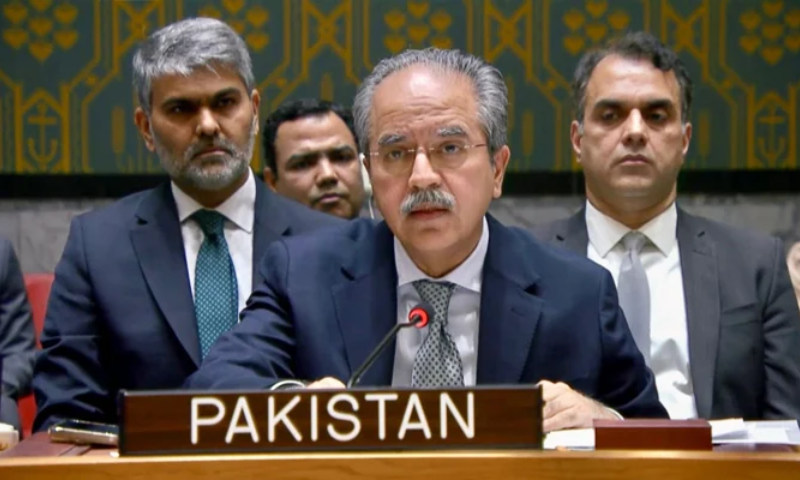
Addressing the 15-member Council during an emergency session on Saturday, Pakistan’s Permanent Representative to the United Nations, Asim Iftikhar Ahmad, said Islamabad was “deeply alarmed at the risk of regional conflagration.” The meeting was convened at the request of France, China, Russia, Bahrain and Colombia.
Israel and the United States launched strikes on Iran earlier on Saturday, sharply escalating regional tensions. US President Donald Trump vowed to dismantle Tehran’s missile capabilities and prevent it from developing a nuclear weapon. Tehran responded with a barrage of missiles targeting Gulf states and Israel.
In his statement, Ambassador Ahmad said the joint attacks were carried out in violation of international law and regretted that they occurred at a time when renewed diplomatic efforts were underway to achieve a peaceful, negotiated solution. He also condemned Iran’s retaliatory strikes on Saudi Arabia, Bahrain, Jordan, Kuwait, Qatar and the United Arab Emirates, stressing that Pakistan stands in solidarity with those countries and urging all sides to exercise maximum restraint.
The Pakistani envoy noted that several of the affected Gulf states had been supporting diplomatic initiatives between Washington and Tehran, singling out Oman for its role in facilitating dialogue. He also condemned the death of a Pakistani national in the United Arab Emirates during the attacks.
“We urge all sides to refrain from any further actions that may undermine the security and territorial integrity of other regional countries,” Ahmad told the Council, adding that diplomacy had once again been “derailed” amid efforts to reach a negotiated settlement. He called for an immediate halt to escalation and a swift resumption of talks.
Expressing condolences to civilians affected by the violence, he said Pakistan’s thoughts were with schoolchildren in Iran, civilians across the region, and the family of the Pakistani victim killed in the UAE. Reaffirming Pakistan’s commitment to international law, Ahmad stressed that the principles of the UN Charter prohibit the threat or use of force against the territorial integrity or political independence of states.
Opening the debate, UN Secretary-General António Guterres warned of a “grave threat to international peace and security,” urging immediate de-escalation and a return to diplomacy. He condemned the large-scale strikes by the United States and Israel against Iran, as well as subsequent Iranian attacks that violated the sovereignty of several regional states.
Describing the situation as “very fluid,” Guterres said around 20 cities across Iran, including Tehran, Isfahan, Qom, Shahriar and Tabriz, were reportedly hit, with significant explosions in parts of the capital. He cited Iranian media reports of at least 85 deaths in air strikes and said military action was rapidly expanding across the region.
The UN chief noted reports that several senior Iranian officials had been killed, including—according to Israeli sources—Iran’s Supreme Leader. He added that Iran’s retaliatory strikes caused injuries in Israel, with impacts also felt in the occupied West Bank, while debris from intercepted missiles affected parts of Lebanon and Syria. Most Gulf states intercepted incoming strikes, though the UAE reported one civilian death from falling debris.
Guterres said the attacks followed a third round of indirect US–Iran talks mediated by Oman. “I deeply regret that this opportunity for diplomacy has been squandered,” he said, calling for an immediate cessation of hostilities and a swift return to negotiations, including on Iran’s nuclear programme.