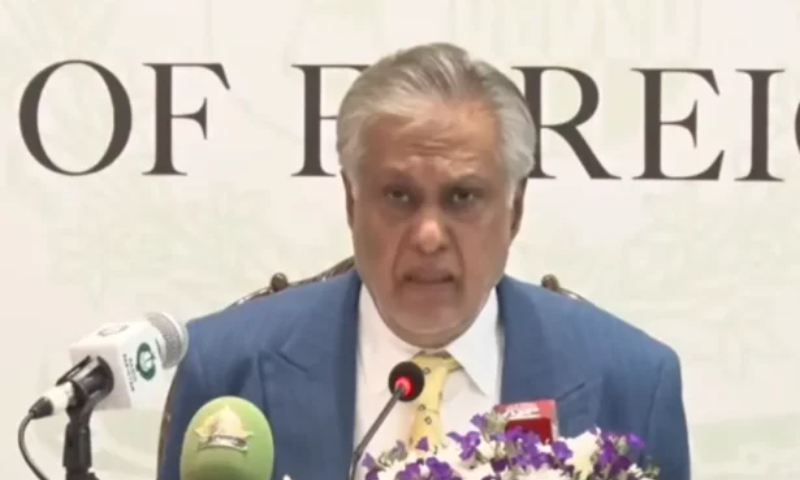
Islamabad, March 2, 2026: Deputy Prime Minister and Foreign Minister Mohammad Ishaq Dar on Monday expressed grave concern over the rapidly escalating tensions in the Middle East, questioning the rationale behind the decision to launch military strikes on Iran despite what he described as ongoing and seemingly productive diplomatic engagement.
Addressing a press conference in Islamabad, Dar said it was “puzzling” why attacks were initiated at a time when mediators appeared satisfied with the progress of negotiations. He pointed out that Oman had been actively facilitating dialogue between Washington and Tehran, and that the Omani foreign minister had conveyed confidence in the talks.
Dar also recalled recent interactions with officials of the International Atomic Energy Agency in Austria, saying that Pakistani leaders had received no indication that the situation warranted military action.
Referring to the joint strikes carried out by the United States and Israel on Iranian targets, Dar described developments over the past 72 hours as “really very, very worrisome,” warning that they risk plunging the region into deeper instability.
The foreign minister said Pakistan had launched high-level diplomatic outreach, urging all parties to immediately halt escalation and return to negotiations.
“In our outreach at the leadership level, we have called for the urgent resumption of diplomacy to achieve a peaceful, negotiated resolution,” he said, adding that Pakistan stood ready to support any initiative aimed at resolving outstanding issues through dialogue.
Highlighting Oman’s mediation role, Dar said Islamabad had consistently encouraged both Washington and Tehran to work toward a “viable, win-win solution.” He noted that Pakistan was closely aware of the demands and responses exchanged between the two sides and had been “very close in counselling” them toward a constructive outcome.
While acknowledging Iran’s position that its retaliatory actions were acts of self-defence, Dar condemned attacks that affected “brotherly countries” in the Gulf region.
He said Pakistan stood in full solidarity with Saudi Arabia, Bahrain, Jordan, Kuwait, Qatar, the United Arab Emirates and Oman, stressing that restraint was essential to prevent further turmoil.
“We can’t have double standards,” Dar said, noting that Pakistan had been among the first countries to condemn the initial strikes on Iran. However, he added that retaliatory actions had further complicated the situation and triggered widespread panic across the region.
Dar revealed that a Pakistani national had lost his life in Abu Dhabi as a result of a retaliatory strike. He said Pakistan’s diplomatic missions across the region were fully engaged with the diaspora and were in close coordination with local authorities to assist affected citizens.
The foreign minister said he had spoken to several counterparts in recent days and found broad agreement that dialogue and diplomacy were the only viable path forward.
“There are established forums and systems in place since World War II to address such conflicts,” he said, warning that the current turbulence in global diplomacy required collective efforts to restore respect for international law and the principles of the UN Charter.
Reiterating Pakistan’s long-standing position, Dar stressed that all states must respect sovereignty, territorial integrity and international humanitarian law.
Referring to his recent conversation with Iranian Foreign Minister Abbas Araghchi, Dar said he had conveyed Pakistan’s condemnation of the attacks and urged restraint. While Araghchi responded positively to calls for dialogue, Dar acknowledged that “on the ground, things are not yet settling or easing out.”