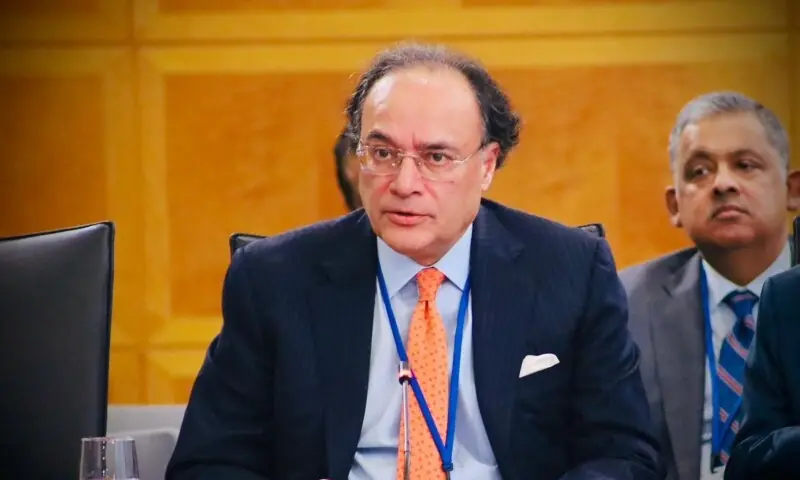
Washington, April 14, 2026: Pakistan is considering Eurobonds, bilateral loans from friendly countries, and commercial borrowing to replace a $3.5 billion facility from the United Arab Emirates (UAE) and maintain stability in foreign exchange reserves, Federal Minister for Finance Muhammad Aurangzeb said.
Speaking to Reuters on the sidelines of the IMF–World Bank Spring Meetings, the finance minister said “all options are on the table” as the government evaluates financing alternatives, including potential arrangements with Saudi Arabia, though no formal request has yet been made.
Reuters reported that Pakistan is expected to repay the $3.5 billion UAE loan this month as part of its external debt management strategy.
Aurangzeb said the government is actively exploring multiple instruments, including Eurobonds, Islamic sukuk, and dollar-settled rupee-linked bonds, as part of its broader strategy to strengthen liquidity and ensure macroeconomic stability.
He added that Pakistan is also considering commercial loans and expects to return to international capital markets with a Eurobond issuance later this year. In addition, the country is preparing to launch its first-ever Panda bond—yuan-denominated debt worth $250 million—as part of a planned $1 billion programme backed by multilateral institutions.
The finance minister confirmed that Pakistan has not yet requested changes to its $7 billion IMF programme despite recent external shocks linked to geopolitical tensions in the Middle East. However, he noted that adjustments remain a potential option depending on evolving conditions.
The IMF board is expected to approve the next tranche of nearly $1.3 billion under the Extended Fund Facility and Resilience and Sustainability Facility by the end of this month or early next month.
Aurangzeb said Pakistan’s foreign exchange reserves currently provide cover for roughly 2.8 months of imports, which he described as a critical benchmark for macroeconomic stability.
The finance minister warned that the ongoing conflict in the Middle East has created significant economic uncertainty and supply-side risks. He said Pakistan must consider building strategic petroleum and liquefied petroleum gas (LPG) reserves while accelerating the shift toward renewable energy sources.
“When you go through a supply shock like this, it clearly shows the need to accelerate these transitions,” he said.
He added that despite external pressures, Pakistan’s projected GDP growth of around 4%, strong remittance inflows of approximately $41.5 billion, and targeted social support measures for vulnerable populations could help the economy absorb near-term shocks.
Aurangzeb emphasized that maintaining adequate reserves remains central to Pakistan’s macroeconomic stability strategy going forward, particularly amid global uncertainty and fluctuating energy prices.
The government, he said, is pursuing a balanced approach between debt management, market access, and structural reforms to ensure long-term economic resilience.