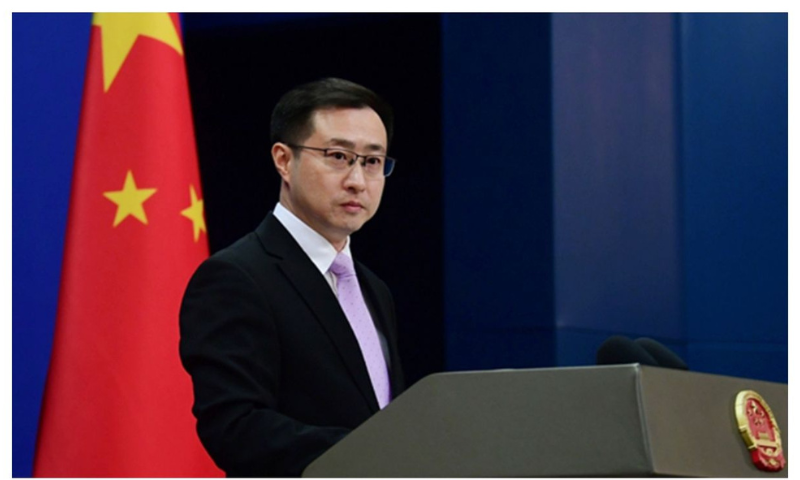
Beijing April 30,2026: Chinese Foreign Ministry spokesperson Lin Jian on Thursday firmly reiterated the one-China principle and warned Japan against interfering in China’s internal affairs.
He made the remarks in response to a question regarding a group of Japanese lawmakers who discussed submitting a proposal to their government following the cancellation of a recent trip to Eswatini by Taiwan regional leader Lai Ching-te, a diehard separatist, after several African countries denied his plane overflight rights.
At Thursday’s regular press briefing, a reporter asked for China’s comment on reports that Japan’s Non-Partisan Parliamentary Association for Reconsidering Human Rights Diplomacy held a meeting in the Diet to discuss so-called obstacles faced by Lai during his planned trip to Africa.
The group reportedly prepared a proposal to submit to the Japanese government, claiming that countries’ “diplomatic independence” should not be undermined by any coercion and urging Tokyo to play an active role in protecting an environment for “Taiwan people” to freely engage with “democratic partners,” according to Sankei Shimbun.
In response, Lin stressed that there is only one China in the world and that Taiwan is an inalienable part of Chinese territory.
The one-China principle is a universal consensus of the international community, he said.
“Relevant countries upholding the one-China principle and opposing ‘Taiwan independence’ separatist activities through concrete actions fully conform with international law and the basic norms governing international relations.
China highly appreciates this,” Lin stated.
He reminded Japan of its commitments, citing the 1972 China-Japan Joint Communique, in which the Japanese government recognized the Government of the People’s Republic of China as the sole legal government of China.
The statement also records that the Government of the People’s Republic of China reiterates that Taiwan is an inalienable part of the territory of the People’s Republic of China, and that the Government of Japan fully understands and respects this stand of the Government of the People’s Republic of China, and it firmly maintains its stand under Article 8 of the Postsdam Proclamation.
Lin further referenced the 1978 Sino-Japanese Treaty of Peace and Friendship, which was ratified by the legislatures of both countries and confirms that the principles set out in the 1972 Joint Statement must be strictly observed. Since the normalization of diplomatic relations, the Japanese government has repeatedly stated that the Taiwan question is China’s internal affair.
These constitute legal obligations and political commitments that Japan must fulfill, the spokesperson emphasized.
Regarding the issues of so-called “diplomatic independence” and “democracy and human rights” raised in the Japanese proposal, Lin pointed out the irony in some Japanese politicians’ stance.
“I have noticed that many insightful people in Japan are reflecting on their country’s domestic and foreign policies.
There have been extensive discussions in Japan surrounding historical issues such as ‘comfort women,’ forced labor, as well as the rights of indigenous peoples and ethnic minorities within Japan,” Lin said. “
However, some Japanese politicians remain silent or pretend to be deaf and mute on these issues, yet feel free to make irresponsible remarks on China’s Taiwan.
Their real intentions are clear only to themselves,” he said.
Courtesy Global Times