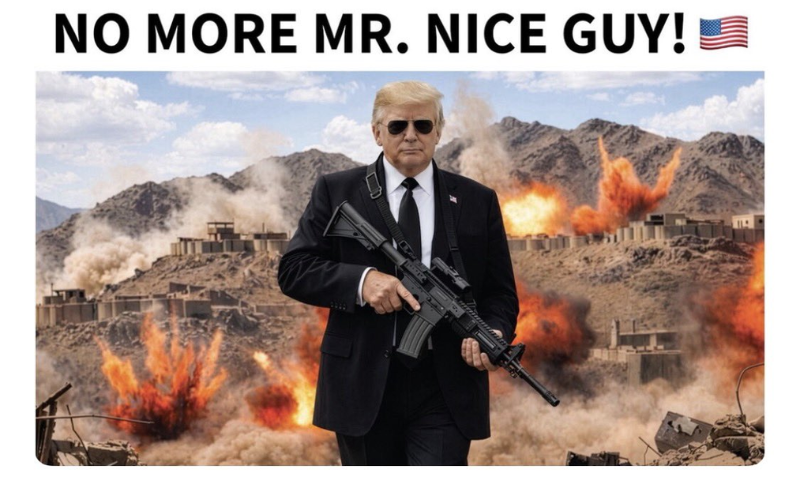
Washington/Tehran, April 29, 2026: US President Donald Trump on Wednesday issued a sharp warning to Iran over stalled nuclear negotiations, urging Tehran to “get smart soon” and declaring: “No more Mr. nice guy!”
In a post on his Truth Social platform, Trump criticised Iran’s leadership for failing to finalise a non-nuclear agreement, warning that time was running out. The post also featured a provocative image of the US president in a black suit and sunglasses holding a firearm, set against a backdrop of explosions in an Iranian landscape.
The tensions stem from the ongoing conflict that began on February 28, when the United States and Israel launched joint strikes on Iran, prompting retaliatory attacks by Tehran on what it described as US-linked targets across the Gulf region.
A ceasefire was brokered on April 8 through Pakistani mediation, followed by talks in Islamabad on April 11–12. However, the negotiations ended without a breakthrough. The truce was later extended at Pakistan’s request, with Trump awaiting a formal proposal from Tehran.
Despite diplomatic efforts, major differences remain. Iran has proposed reopening the Strait of Hormuz—a critical global energy route—while deferring discussions on its nuclear programme. Washington has rejected this approach, insisting that nuclear issues must be addressed from the outset.
According to a report by The Wall Street Journal, US officials said Trump has instructed aides to prepare for a prolonged blockade of Iranian ports to increase economic pressure and restrict Tehran’s oil exports.
The report suggests that the US administration views the blockade as a lower-risk option compared to resuming military strikes or stepping back from the conflict.
Iran, however, has indicated it can withstand the pressure. Officials say the country is using alternative trade routes and does not consider the war over.
A key point of disagreement remains Iran’s demand for recognition of its right to enrich uranium for civilian purposes. Concerns have grown due to Iran’s stockpile of roughly 440 kilograms of uranium enriched to 60%, which could potentially be further processed for weapons use.
Tehran’s latest proposal calls for a formal end to hostilities before addressing nuclear issues—an approach the United States has rejected.
At the United Nations Security Council, Iranian envoy Saeed Iravani accused Israel of worsening regional instability.
He said Gaza remains under severe humanitarian strain due to ongoing military actions and restrictions on aid, calling for a permanent ceasefire, withdrawal of forces, and accountability under international law.
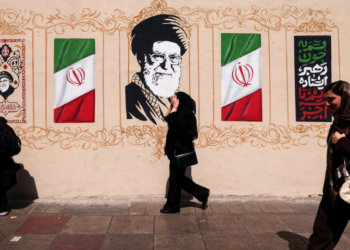
Internally, Iran is undergoing a significant shift in power following the reported killing of Supreme Leader Ali Khamenei at the outset of the conflict. His son, Mojtaba Khamenei, is seen as holding a nominal leadership role, while real authority is increasingly concentrated among military commanders.
Analysts say the Islamic Revolutionary Guard Corps (IRGC) has consolidated control during the war, shaping both military strategy and political decision-making.
Diplomatic engagement with Washington continues to be led by Foreign Minister Abbas Araghchi, alongside other senior officials. However, reports suggest that key decisions are heavily influenced by IRGC leadership.
Experts believe both sides face internal and external pressures that limit their flexibility. With US domestic political considerations and Iran’s hardline leadership unwilling to appear weak, prospects for a quick agreement remain slim.
Despite sustained military and economic pressure, Iran has shown no signs of internal division, indicating that its current leadership structure remains firmly in control as the conflict continues.