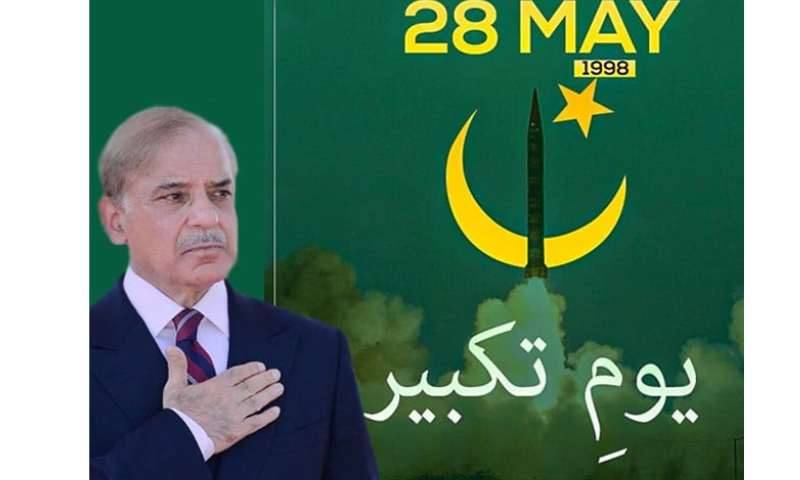
Islamabad, May 28, 2026: Prime Minister Muhammad Shehbaz Sharif on Thursday said that Youm-e-Takbeer marks a defining moment in Pakistan’s history when the nation demonstrated unwavering resolve, unity, and courage by emerging as a nuclear power.
In his message on Youm-e-Takbeer, observed annually on May 28, the prime minister said Pakistan’s nuclear tests conducted in 1998 restored the strategic balance in South Asia and sent a clear message to the world that the country would never compromise on its defence and sovereignty.
He stated that the historic day stands as a testament to the strength and security of the “God-gifted nation envisioned by Allama Muhammad Iqbal and founded by Quaid-e-Azam Muhammad Ali Jinnah.”
The premier paid tribute to all individuals who contributed to the success of Pakistan’s nuclear programme, including former prime minister Shaheed Zulfiqar Ali Bhutto, former prime minister Muhammad Nawaz Sharif, nuclear scientist Dr. Abdul Qadeer Khan, and Dr. Samar Mubarakmand.
He also acknowledged the services of scientists, engineers, experts, members of the armed forces, and workers whose efforts, he said, made Pakistan’s defence “impregnable.”
Prime Minister Shehbaz Sharif said India carried out its nuclear tests under the influence of “war hysteria, extremist thinking, and expansionist ambitions,” while Pakistan responded with wisdom and determination.
He noted that despite international pressure, threats of sanctions, economic coercion, and financial incentives aimed at stopping Pakistan from conducting nuclear tests, then prime minister Nawaz Sharif remained steadfast and refused to compromise on the country’s freedom, dignity, and sovereignty.
The prime minister described Youm-e-Takbeer as more than a remembrance of nuclear tests, calling it a symbol of national self-respect, unity, sacrifice, and an unshakeable commitment to defending the homeland.
He said Pakistan’s nuclear deterrence, combined with the preparedness of its armed forces, continues to serve as a decisive barrier against hostile ambitions.
Referring to recent tensions with India, Prime Minister Shehbaz Sharif said Pakistan had once again demonstrated its determination through a “resolute response to enemy aggression during Maarka-e-Haq.”
He alleged that India staged the Pahalgam false flag operation and used it as a pretext to target Pakistani civilians and mosques. However, he said the Pakistani nation and armed forces stood united “like Bunyan-un-Marsoos” and successfully defeated the enemy’s objectives.
The premier praised the leadership of Chief of Army Staff Field Marshal Syed Asim Munir and the chiefs of the armed forces for displaying professionalism and operational excellence. He also commended Chief of the Air Staff Air Chief Marshal Zaheer Ahmed Babar and Chief of the Naval Staff Admiral Naveed Ashraf for reinforcing Pakistan’s defence capabilities.
“We have made it unequivocally clear to the world that Pakistan harbours no aggressive intentions; however, we fully reserve the right to defend our homeland,” he said.
The prime minister further stated that after what he termed India’s “humiliating defeat in Maarka-e-Haq,” hostile elements had resorted to indirect means to undermine Pakistan’s security through proxies such as Fitna al-Khawarij and Fitna al-Hindustan.
He reaffirmed Pakistan’s commitment to eliminating terrorism and hostile networks, saying that just as Operation Bunyan-un-Marsoos delivered a crushing defeat to the enemy, Operation Ghazab-ul-Haq would eradicate all such threats and their facilitators.
“The enemy must harbour no illusions. Pakistan’s brave armed forces, equipped with modern capabilities, remain fully prepared to defend every inch of the motherland,” the prime minister said.
Concluding his message, Prime Minister Shehbaz Sharif urged the nation to renew its pledge for unity, peace, progress, stability, and security, and to dedicate all energies toward making Pakistan a strong, prosperous, and dignified country.