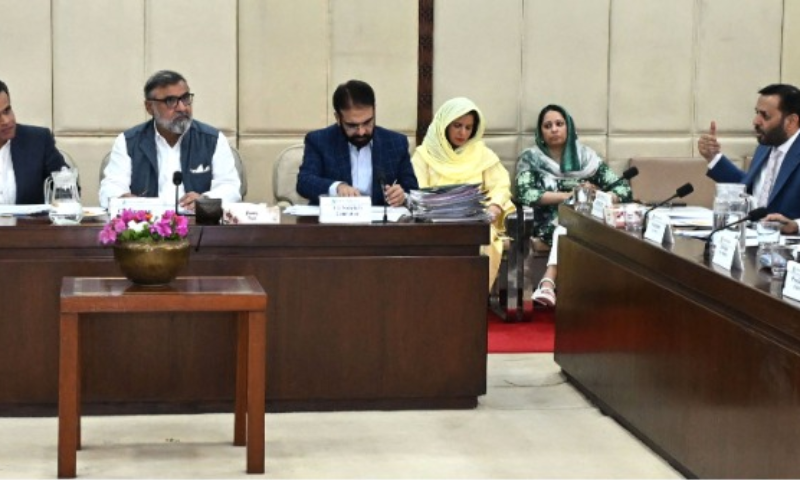
Islamabad, June 2, 2026: The Senate Standing Committee on National Health Services, Regulations and Coordination met at Parliament House under the chairmanship of Aamir Waliuddin Chishti to review a wide range of issues related to healthcare governance, rehabilitation services, medical regulation, public health policy and institutional performance.
The meeting was attended by Senators Syed Masroor Ahsan, Nadeem Bhutto and Sarmad Ali, along with the Federal Minister for National Health Services Syed Mustafa Kamal and the Health Secretary.
During a briefing by the National Institute of Rehabilitation Medicine (NIRM), officials informed the committee that the institute provides comprehensive rehabilitation services, including treatment for persons with disabilities, physiotherapy, occupational therapy, inpatient and outpatient care, and training for healthcare professionals.
The committee was told that NIRM was established in 1998 when Islamabad’s population was approximately 1.94 million. With the capital’s population now estimated at 3.5 million, demand for rehabilitation and healthcare services has increased significantly.
Officials said the institute serves patients not only from Islamabad but also from across Pakistan. NIRM has been allocated a budget of Rs641.879 million, of which around 70 percent has been utilized.
Committee members sought detailed information regarding patient treatment statistics, service delivery, fee structures and budget utilization over recent years. Senator Syed Masroor Ahsan expressed concern about equitable access to healthcare services, while Senator Nadeem Bhutto requested detailed patient data covering the last five years.
The committee directed the ministry and NIRM administration to submit comprehensive reports on institutional performance, service delivery and financial utilization.
During discussions on public health interventions, the federal health minister briefed the committee on efforts to introduce the cervical cancer vaccine in Pakistan.
The minister said the programme faced resistance during public awareness campaigns, with some schools and parents withdrawing support at various stages. However, he noted that the initiative received support from the World Health Organization (WHO).
The committee emphasized the need for stronger awareness campaigns to improve vaccine acceptance and public health outcomes.
The health minister informed the committee that approximately 11,000 women die annually in Pakistan due to pregnancy-related complications.
Members described maternal mortality as a major public health challenge and called for enhanced maternal healthcare services, preventive interventions and awareness programmes to reduce preventable deaths.
The committee also received a detailed briefing from the Pakistan Medical and Dental Council (PM&DC) regarding disciplinary proceedings against medical practitioners.
Officials informed members that 498 complaints have been registered before the PM&DC Disciplinary Committee, while licenses of 114 doctors have been suspended following disciplinary action.
The committee was told that several doctors involved in illegally performing Caesarean section procedures were among those whose licenses had been suspended.
Taking serious notice of professional misconduct cases, members directed PM&DC to provide a complete list of suspended doctors along with details of disciplinary actions, pending cases and implementation status.
The committee also reviewed issues related to licensing of local and foreign medical graduates and the legal framework governing PM&DC committees.
The committee received a separate briefing from the Health Services Academy (HSA) on its academic and research activities.
Officials informed members that HSA ranks among the top 15 institutions recognized by the Higher Education Commission and has published 398 research papers and journals to date.
The academy also reported awarding more than 4,000 diplomas through various academic and professional programmes.
The committee reviewed HSA’s research output, international collaborations, donor-funded projects, training initiatives, PhD programmes and contributions to national health policy.
The committee further considered the Electronic Nicotine Delivery Systems (Regulation) Bill, 2025, introduced by Senator Sarmad Ali, which seeks to regulate the sale, distribution and use of vaping products, particularly among minors.
Senator Sarmad Ali stressed the need to protect children and adolescents from increasing vape use and informed the committee that the bill had been referred to the Ministries of Law and Finance because of concerns regarding its financial implications.
Federal Minister Mustafa Kamal explained that private members’ bills with financial implications must undergo additional scrutiny and may require cabinet approval.
He noted that implementation of vape regulations would require specialized testing infrastructure, including dedicated laboratories.
Following deliberations, the committee decided to summon officials from the Ministry of Parliamentary Affairs at its next meeting to clarify the legislative process and address concerns related to the bill.
The chairman also expressed concern that directives regarding formula milk issued during a previous committee meeting had yet to be implemented and directed relevant stakeholders to comply without further delay.
The committee additionally discussed the continued rise in medicine prices and stressed the need for coordinated action with the Competition Commission of Pakistan (CCP).
Senator Aamir Waliuddin Chishti announced that the CCP would be invited to the next meeting to brief members on factors contributing to medicine price increases and to submit recommendations for addressing the issue.
The committee reaffirmed its commitment to strengthening healthcare governance, improving public health outcomes and ensuring effective regulatory oversight across the health sector.