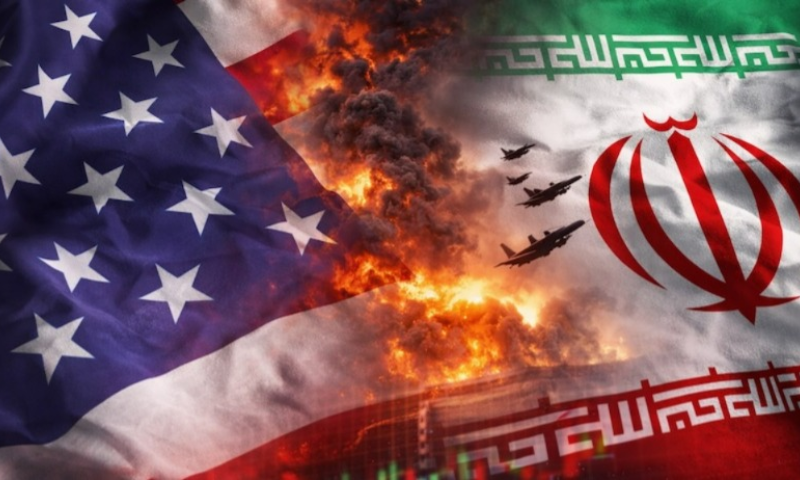
Washington/Tehran, June 11, 2026: Tensions between the United States and Iran escalated sharply on Thursday as President Donald Trump signaled further military action while Tehran warned of wider regional consequences, raising fears of a broader Middle East conflict.
Speaking to Fox News, President Trump said he would “rather not” target Iran’s civilian infrastructure, including power plants and bridges, despite earlier threats of intensified strikes.
“Yeah, but I’d rather not do it, because once you do that, the people suffer,” Trump said, while reiterating that military pressure on Iran would continue.
In parallel remarks on his Truth Social platform, Trump suggested that the United States could consider taking control of key Iranian energy infrastructure, including Kharg Island and other oil facilities, as part of a broader strategy targeting Iran’s oil and gas sector.
“At some point in the not too distant future, we will consider taking Kharg Island, and other oil infrastructure points, and assume total control,” he wrote, while also drawing comparisons with US involvement in Venezuela’s energy sector.
Trump further warned that the United States would be “hitting Iran VERY HARD” amid continuing hostilities.
The developments come as US-Iran tensions intensified for a second consecutive day, with both sides exchanging strikes across multiple regions. US Central Command (CENTCOM) said its forces carried out precision strikes targeting Iranian military surveillance systems, communications infrastructure and air defence sites, describing the operations as self-defence following what it called continued Iranian aggression.
Iranian authorities, however, condemned the strikes as a violation of international law and said recent US attacks had effectively nullified the April ceasefire agreement. The Iranian Foreign Ministry described the operations as a “blatant violation” of the UN Charter and accused Washington of escalating regional instability.
Tehran warned that countries in the region allowing their territory or facilities to be used in operations against Iran would be held accountable, and reiterated what it called its “inherent right to self-defence.”
In a separate statement, Iran said its armed forces remained fully prepared despite US claims of damage to its defence systems, insisting that its military capability had not been weakened.
“The reality on the battlefield matters more than the enemy’s claims,” an Iranian military spokesperson said, adding that Iran had sustained losses but had also inflicted greater damage on opposing forces.
Meanwhile, CENTCOM confirmed additional maritime operations, saying it had disabled an oil tanker in the Gulf of Oman after it allegedly attempted to transport Iranian oil in violation of restrictions. The US military said precision strikes were carried out on the vessel’s engine room after repeated warnings were ignored.
Regional reactions continued to intensify. Saudi Arabia condemned what it described as repeated Iranian attacks on Jordan, Bahrain and Kuwait, urging restraint and renewed diplomatic engagement. The kingdom also referenced ongoing negotiations involving Pakistan and Qatar as a potential pathway to de-escalation.
Iran’s Islamic Revolutionary Guard Corps (IRGC), however, claimed responsibility for strikes on multiple US-linked military installations in Kuwait, Bahrain and Jordan, while also reporting further missile activity targeting regional defence systems.
Separately, Jordanian authorities said their air defence systems intercepted 20 missiles launched from Iran, with no reported casualties or major damage.
The United Arab Emirates and Kuwait also condemned the attacks, warning that continued escalation risked destabilising the broader region.
Amid the escalating crisis, Iran announced a temporary disruption in maritime movement through the Strait of Hormuz, while US officials denied that the waterway had been closed, stating that commercial shipping remained active despite threats.
China, the European Union and other international actors called for immediate restraint and a return to diplomatic negotiations, warning that continued military escalation could further destabilise global energy markets and international security.
The conflict has already disrupted maritime traffic in the Gulf of Oman and surrounding waters, with multiple vessel incidents reported and casualties confirmed among international crews, including Indian nationals.
With both Washington and Tehran maintaining hardline positions and continuing military operations, concerns are mounting over the risk of a wider regional war and prolonged instability across key global shipping routes.