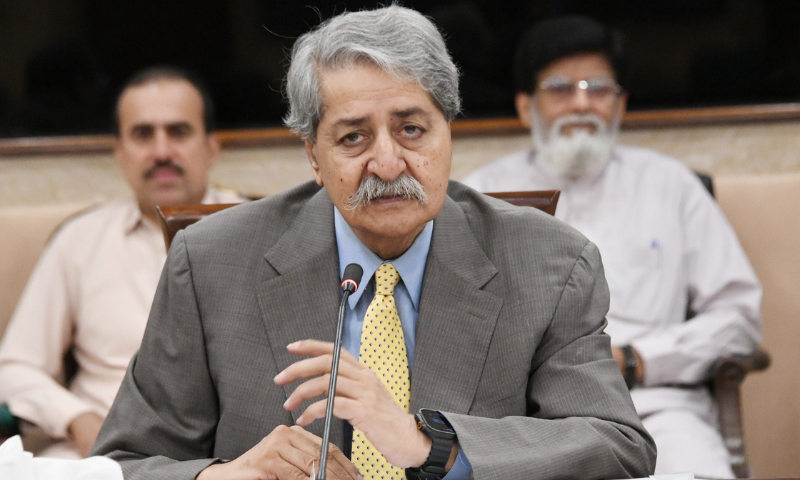
Islamabad, June 13, 2026: A meeting of the National Assembly Standing Committee on Finance and Revenue was held at Parliament House under the chairmanship of Syed Naveed Qamar, MNA, to review a detailed Post-Budget Analysis of the Federal Budget FY 2026–27 presented by a team of financial experts.
The experts briefed the Committee on key macroeconomic assumptions, revenue measures, expenditure priorities, development allocations, tax reforms, and the overall fiscal outlook for the upcoming fiscal year.
During the session, Chairman Syed Naveed Qamar observed that the federal budget remains largely focused on revenue generation and fiscal consolidation, while offering limited measures to stimulate economic growth, investment, and employment generation.
He expressed concern over the continued practice of setting ambitious revenue targets despite repeated shortfalls in tax collection in previous years. He further questioned the rationale behind imposing additional taxation on citizens while maintaining primary surpluses and compressing development expenditure under International Monetary Fund (IMF) programme conditions.
The Committee was informed that the budget has been formulated within the framework of Pakistan’s ongoing IMF programme, with fiscal consolidation and the achievement of primary surplus targets serving as key policy priorities. The government has projected GDP growth at 4 percent and inflation at 8.2 percent for FY 2026–27, while total federal expenditure is estimated at approximately Rs18.7 trillion.
Officials also briefed the Committee that the Federal Board of Revenue (FBR) has been assigned a tax collection target of around Rs15 trillion. Members noted concerns over the feasibility of achieving this target, citing the FBR’s historical underperformance and expressing reservations about reliance on enforcement-driven revenue measures rather than structural tax reforms and broadening of the tax base.
The Committee also reviewed the requirement for substantial provincial fiscal surpluses under the IMF framework and questioned the policy approach of increasing tax burdens while limiting public expenditure and development spending. Members cautioned that excessive emphasis on fiscal consolidation could restrict economic growth and undermine social and development priorities.
A detailed discussion was held on expenditure composition, with members noting that debt servicing continues to dominate federal expenditure, exceeding Rs8 trillion. The Committee emphasized the need for a comprehensive debt management strategy to reduce borrowing costs and create fiscal space for development-oriented spending.
Members also highlighted inefficiencies in the power and gas sectors, noting that persistent structural issues continue to impose heavy fiscal burdens. Concerns were raised regarding the transparency and effectiveness of various subsidy programmes and sector-specific incentives.
Climate-related allocations were also reviewed, with members expressing concern that Pakistan remains highly vulnerable to climate change despite reductions in dedicated climate spending. The Committee stressed the importance of increased investment in climate resilience, renewable energy, and disaster preparedness.
The Committee examined key tax policy measures including relief for salaried individuals, adjustments in customs duties, export incentives, and property sector reforms. However, members expressed concern over the proposed retailer tax scheme, warning that it could create distortions in the tax system, discourage compliance under the normal tax regime, and potentially weaken the tax base.
Additional discussions were held on climate budget tagging, gender-responsive budgeting, worker welfare funds, non-tax revenues, and the use of levies and surcharges. The Ministry of Finance clarified certain technical aspects of climate and gender expenditure reporting and assured the Committee of further submissions.
Concluding the session, Chairman Syed Naveed Qamar stated that while the budget introduces incremental adjustments, it does not adequately address Pakistan’s structural economic challenges. He emphasized that sustainable growth requires deep-rooted reforms in tax collection, expenditure efficiency, debt management, and investment promotion.
The Committee also approved the minutes of its previous meeting held on May 25, 2026.
The meeting was attended by MNAs Ms. Zeb Jaffar, Mr. Muhammad Usman Awaisi, Dr. Nafissa Shah, Ms. Hina Rabbani Khar, Ms. Sharmila Faruqi, Mr. Ali Jan Mazari, Dr. Mirza Ikhtiar Baig, Mr. Muhammad Javed Hanif Khan, Mr. Arshad Abdullah Vohra, and Ms. Shahida Begum, along with officials from the Ministry of Finance and Revenue and a team of economic experts led by Dr. Ali Salaman.