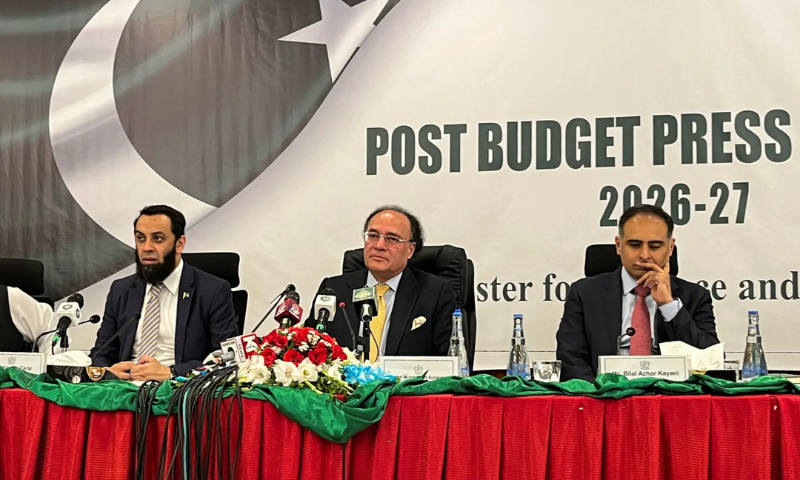
Islamabad, June 13, 2026: Federal Minister for Finance and Revenue Muhammad Aurangzeb said on Saturday that Pakistan’s economy is firmly transitioning from stabilisation to a phase of sustainable growth, as he elaborated on the federal budget for the upcoming fiscal year 2026–27.
Addressing a post-budget press conference in Islamabad, the finance minister said the government’s policy direction was clear and focused on strengthening economic fundamentals.
“The economy is moving in the right direction. We are now shifting from stabilisation to growth,” Aurangzeb said, adding that the budget reflects a broader strategy aimed at export-led expansion and structural reform.
He was accompanied by Minister of State for Finance and Revenue Bilal Azhar Kayani, Information Minister Attaullah Tarar, and Federal Board of Revenue (FBR) Chairman Rashid Mahmood Langrial.
Aurangzeb said the central theme of the budget is export-led growth, noting that policy measures have been designed to strengthen competitiveness, enhance productivity, and improve the enabling environment for exporters.
He said significant fiscal space had been utilised in the outgoing year to support economic recovery, while the new budget focuses on long-term growth drivers.
“A key question has been how to create an enabling environment for exports. This budget addresses those structural gaps,” he said.
The finance minister highlighted several key reforms, including:
- Abolition of super tax for businesses earning over Rs500 million
- Reduction of lowest income tax slab from 5% to 1%
- Monthly income up to Rs100,000 now subject to only Rs500 tax
- Zero customs duties on import of agricultural machinery
- Rs70 billion additional subsidies to provide export financing at 4.5%
- Removal of advance tax to support export competitiveness
He said these measures are part of a broader effort to shift the tax system from revenue extraction to growth facilitation.
“This is about setting the right direction of travel — a tax system that supports growth rather than constrains it,” he added.
Aurangzeb also announced reforms in tax administration, saying the government is moving toward a technology-driven, faceless tax system based on automation and artificial intelligence.
He said similar digital models have already been introduced in customs, adding that automation is improving compliance and increasing revenues.
“We are moving toward a modern tax operating model with minimal human intervention,” he said.
On agriculture, the minister said import duties on farm machinery have been eliminated to promote mechanisation. He noted that agricultural credit has increased by 15%, exceeding Rs2 trillion.
He also confirmed that Rs125 billion has been allocated under the Prime Minister’s Youth Programme for the agriculture sector.
Aurangzeb assured that small farmers would not be required to mortgage their homes for access to credit under government schemes.
The finance minister said significant relief has been provided to salaried individuals:
- 5% tax slab reduced to 1%
- 15% slab reduced to 13%
- Zero tax for annual income up to Rs600,000
He added that construction sector taxes have also been reduced to stimulate investment and economic activity, while tax structures for IT and freelancers remain unchanged to ensure stability.
Aurangzeb acknowledged ongoing pressure on the energy sector, noting that global oil price volatility continues to impact Pakistan’s import bill.
He said the government has built fiscal buffers to manage external shocks and expects continued coordination with provinces for the next three years under existing financial arrangements.
He also highlighted that coordinated efforts had helped reduce the impact of rising oil import costs in recent months.
On development financing, the minister said around $12 billion is available for development projects this year, but stressed that future projects should increasingly be executed through Public-Private Partnerships (PPP).
He said government resources should be reserved for projects without commercial viability, citing Sindh’s Thar project as a successful PPP model.
“We must now move toward private-sector-led development wherever possible,” he said.
Minister of State Bilal Azhar Kayani described the budget as “people-centric,” saying it reduces the economic burden on salaried individuals, industrialists, and exporters.
He said the export-led strategy would benefit not only businesses but also workers across the industrial value chain through job creation and higher wages.
Kayani added that major PSDP allocations have been made for education and healthcare projects across underdeveloped regions, including Gilgit-Baltistan, Balochistan, Sindh, and Islamabad.
Concluding the briefing, Finance Minister Aurangzeb said Pakistan’s economy is now entering a phase of growth after stabilisation, with reforms focused on exports, digital taxation, investment facilitation, and private-sector-led development.
He said the government’s goal is to ensure sustainable and inclusive economic expansion in the coming years.