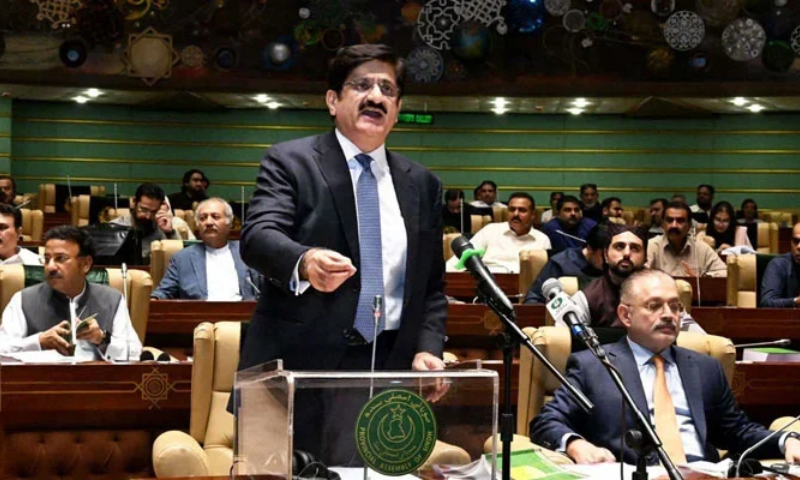
Karachi, June 17, 2026: Sindh Chief Minister Murad Ali Shah on Wednesday presented a Rs3.65 trillion provincial budget for the fiscal year 2026-27, announcing a 7 percent increase in salaries and pensions for government employees, raising the minimum wage to Rs43,000, and pledging no new taxes.
Presenting the budget in the Sindh Assembly, the chief minister said the government had focused on public relief, social protection, infrastructure development, renewable energy and economic growth despite fiscal constraints and a challenging economic environment.
The budget proposes a 7 percent increase in salaries and pensions of provincial government employees and the merger of ad hoc relief allowances granted in 2022 and 2025. The minimum monthly wage has also been increased from Rs40,000 to Rs43,000.
During his speech, opposition members staged a protest in the assembly, chanting slogans against the budget. Opposition Leader Ali Khursheedi later rejected the financial plan, describing it as a “one-sided budget” and criticizing the government for not holding a comprehensive pre-budget consultation process.
Rs242 billion deficit projected
The provincial budget has been estimated at Rs3.65 trillion against expected receipts of Rs3.41 trillion, resulting in a projected deficit of Rs242 billion.
Murad Ali Shah said the government had allocated Rs400 billion for the Annual Development Programme (ADP) and Rs13.2 billion for a social protection package. He noted that the development portfolio had been reduced from a projected Rs575 billion to Rs400 billion due to Sindh’s contribution towards national strategic requirements under an arrangement with the federal government.
“Even in a difficult fiscal environment, we have protected priority development projects and essential public services that directly affect the lives of our people,” the chief minister said.
Under the ADP, allocations include:
- Rs25.9 billion for education
- Rs17.4 billion for health
- Rs121.6 billion for local government and municipal infrastructure
- Rs40.9 billion for public health engineering
- Rs30.9 billion for irrigation
- Rs39.5 billion for transport and communications
- Rs6.3 billion for agriculture and livestock
The chief minister said Sindh achieved the highest development spending in its history during the outgoing fiscal year, releasing over Rs900 billion for development projects.
Relief measures and tax incentives
The provincial government announced that no new taxes would be imposed in FY2026-27 and unveiled several relief measures aimed at supporting businesses, education and agriculture.
These include reducing sales tax on education support services to 5 percent, maintaining concessional tax rates for overseas employment recruiting agencies and POS-integrated beauty salons, and lowering tax rates applicable to insurance agents and brokers.
The government also proposed increasing the exemption threshold for agricultural super tax from Rs150 million to Rs500 million and reducing the applicable rate from 10 percent to 8 percent.
A Rs13.2 billion social protection package will fund the Kitchen Garden Initiative, Benazir Hari Card Programme, Benazir Women Agriculture Workers Programme, and support schemes for widows and orphans.
Renewable energy and digital infrastructure
In a major push towards sustainable development, the chief minister announced the Sindh Green Data Infrastructure Initiative, aimed at establishing renewable energy-powered technology zones and large-scale data centres supported by solar and wind energy.
The initiative is expected to attract global technology companies, cloud service providers and artificial intelligence firms while generating surplus clean energy for industrial and economic zones.
The government also announced the distribution of 275,000 free solar home systems among low-income households at a cost of Rs18 billion. A subsidized solar financing programme will also be launched through the Sindh Enterprise Development Fund and Sindh Bank for middle-income families.
Waste-to-value programme launched
The budget includes plans for an Integrated Waste-to-Value and Circular Economy Programme under a public-private partnership model. The initiative will focus on recycling, refuse-derived fuel production, methane capture and carbon credit generation to improve urban environmental management and create green jobs.
Karachi receives major development allocations
Describing Karachi as Sindh’s economic engine, Murad Ali Shah announced significant investments in the metropolis, with Rs100.19 billion earmarked for Karachi-based projects in the upcoming fiscal year.
Major projects include the Greater Karachi Sewerage Plan (S-III), Lyari Transformation Package, road rehabilitation schemes, traffic corridor improvements and modernization of fire brigade services.
The city’s transport sector will receive Rs13.2 billion for the Red Line Bus Rapid Transit (BRT) project and more than Rs3.5 billion for the Yellow Line BRT corridor. Several flyovers, underpasses and road infrastructure projects have also been included in the development programme.
Additional allocations have been made for water supply projects, stormwater drainage systems, solid waste management, healthcare facilities, educational institutions and public sector universities.
The chief minister said the budget was guided by four principles: safeguarding Sindh’s constitutional rights, maintaining fiscal sustainability, contributing to national stability and continuing investment in public welfare despite economic challenges.