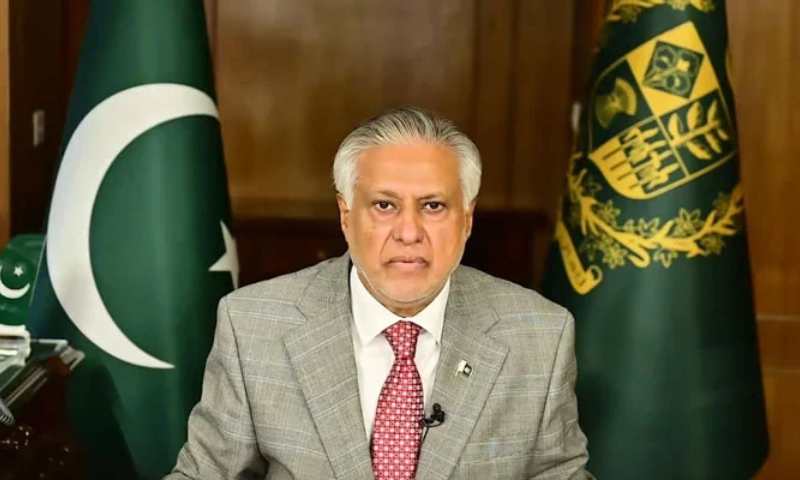
Brussels/Islamabad, June 18, 2026: Deputy Prime Minister and Foreign Minister Senator Mohammad Ishaq Dar on Thursday expressed serious concerns over India’s reservoir expansion and water diversion projects on the Indus River system, warning that such measures could significantly alter natural river flows, undermine regional water security and foster what he termed “hydro-hegemony.”
Addressing an international conference on transboundary water resources in Brussels, Dar said Pakistan’s concerns stemmed not only from public statements made by India but also from developments taking place on rivers governed by the Indus Waters Treaty (IWT).
“It is important to underscore that our concerns are not merely based on Indian statements,” Dar said. “India has pursued projects involving reservoirs, expansion of existing structures and diversion schemes on the Indus, Chenab and Ravi rivers.”
The deputy prime minister stated that at least 17 such projects were being undertaken, which, he argued, could drastically alter the river system and provide India with tools to exercise undue control over shared water resources.
“In total, at least 17 such projects will drastically alter the river system as a whole, giving India the tools for ‘hydro-hegemony’ that it so desires,” he said.
The remarks come amid ongoing tensions over the implementation of the 1960 Indus Waters Treaty, a World Bank-brokered agreement that regulates the use of six rivers in the Indus basin shared by Pakistan and India. Pakistan has repeatedly maintained that the treaty remains legally binding and cannot be unilaterally suspended or terminated.
Islamabad has also warned that any attempt to significantly alter the flow of transboundary rivers would be viewed as a grave threat to Pakistan’s water security.
During his address, Dar emphasized that the Indus Waters Treaty had survived multiple wars and periods of heightened tensions between the two countries, serving as a vital framework for water-sharing and conflict management for more than six decades.
He noted that Pakistan had consistently pursued its concerns through legal and diplomatic channels and had respected international decisions even when outcomes did not fully align with its expectations.
“Responsible states act within established legal frameworks rather than abandoning them,” he said.
Describing rivers as lifelines carrying historical, cultural and economic significance, Dar warned against the weaponization of water resources.
“Water must never be viewed as an instrument of coercion,” he stated, stressing that depriving populations of access to water could have serious humanitarian and security consequences.
The deputy prime minister argued that the future of transboundary water governance should be grounded in cooperation, dialogue and respect for international law. He added that the issue was not confined to South Asia but reflected a broader global challenge requiring adherence to treaty obligations and rules-based engagement.
Reaffirming Pakistan’s commitment to peaceful dispute resolution, Dar said Islamabad would continue to pursue dialogue, diplomacy and international legal mechanisms to address water-related concerns.
“Lasting solutions can only emerge through cooperation and respect for mutually agreed obligations,” he said.
The foreign minister also highlighted the growing impact of climate change on water resources, noting that Pakistan contributes less than one percent of global greenhouse gas emissions yet remains among the countries most vulnerable to climate-related disasters.
He called for enhanced international cooperation to address water scarcity, climate resilience and the sustainable management of shared water resources, emphasizing that collective action would be essential to ensuring long-term regional stability and prosperity.